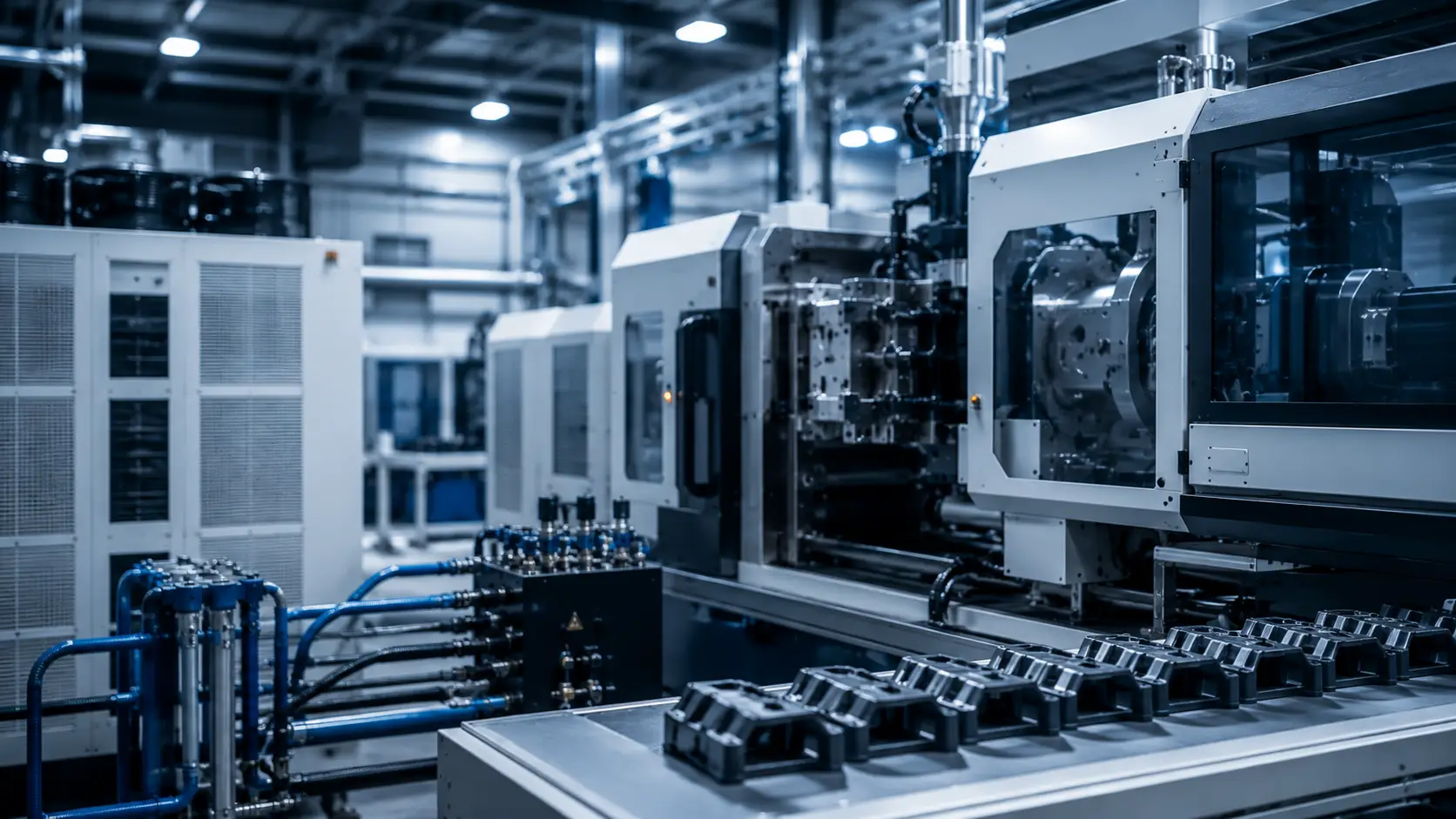
In plastic injection and extrusion, cooling is often the longest single phase of the cycle, which is why a correctly selected chiller and stable mold cooling directly determine a plant's productivity. For the molten polymer to solidify inside the mold, heat has to be extracted quickly and evenly. Even a few degrees of fluctuation in the mold surface temperature lengthens the cycle, shifts part dimensions and drives up the scrap rate. In this article we look at the practical, engineering-focused principles that apply on the shop floor in injection cooling and extrusion cooling processes.
Why Mold Cooling Determines Cycle Time
Within the total time of an injection cycle, the filling and packing phases are relatively short; the real time is spent cooling the part down to a temperature at which it can be safely ejected from the mold. The faster and more uniformly heat is drawn out of the mold, the shorter the cooling phase becomes. But the goal here is not speed alone: the cooling has to be balanced. If one region of the mold cools quickly and another slowly, the part develops warpage, sink marks, internal stresses and dimensional deviation.
That is why stable mold cooling is the critical variable that affects cycle time, part quality and scrap rate all at once. A well-designed cooling circuit means more parts and fewer rejects per hour from the same mold. In extrusion, the challenge is cooling the profile, pipe or film in a stable manner after calibration; any swing in water temperature is reflected directly in dimensional tolerance and surface quality.
Dedicated Process Chiller or Central System?
There are two fundamental approaches to plastic injection chiller architecture. A dedicated, machine-specific process chiller responds exactly to the temperature needs of that mold, and a load change on one machine does not affect the others; maintenance and commissioning can also be managed machine by machine. In a central or shared system, a single cooling source feeds several machines. This offers advantages in floor space, shared redundancy and overall efficiency; however, because load fluctuations between machines can be felt in the common circuit, the hydronic balancing and automation must be well engineered.
The right choice depends on the number of machines, whether the molds require different temperatures from one another, and the expected production flexibility. In shops that change molds frequently and run each mold at a different temperature, a central cooling infrastructure fed through a mold temperature controller on each machine is usually the most balanced solution.
Temperature Stability, ΔT and Flow in the Mold Circuit
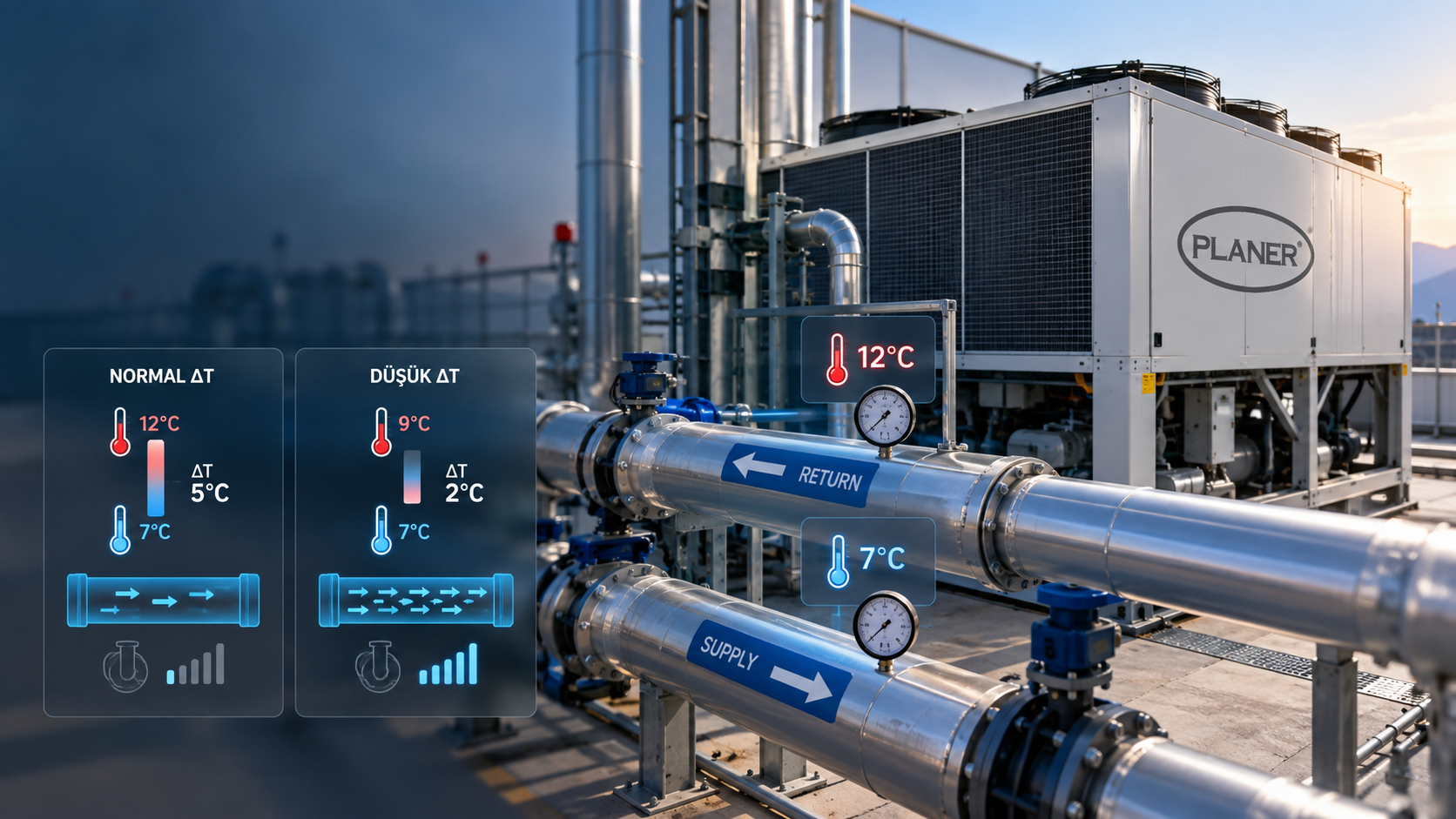
The performance of the mold circuit depends on managing three quantities together: the inlet water temperature, the ΔT (the inlet-to-outlet temperature difference) and the flow rate. Flow in the mold channels must be turbulent; with laminar flow, heat transfer weakens and the mold surface does not cool evenly. As a general rule of thumb, a reasonable ΔT is targeted across the circuit (on the order of a few degrees in most injection applications); if the ΔT grows too large, a temperature difference develops between the inlet and outlet sides of the mold, while keeping it too small results in unnecessarily high flow and pump energy.
Practical points to watch in the field:
- Provide enough flow to maintain turbulent flow in the mold channels; a restricted or clogged channel locally disrupts cooling.
- Keep the inlet water temperature constant; if the chiller set point fluctuates, so do cycle time and part dimensions.
- In applications requiring a low mold temperature, evaluate ambient humidity and surface temperature together to guard against condensation (sweating).
- Use an appropriate proportion of glycol on lines exposed to low temperatures under humidity and at risk of freezing; account for glycol's effect on viscosity and heat transfer when selecting the flow.
- Make each machine's supply and return temperature and flow rate monitorable; on a blindly running circuit, a problem is only noticed once scrap rises.
Water Quality, Closed Loop and Filtration
The most frequently neglected aspect of mold cooling is water quality. Because mold channels are narrow, scale, corrosion products and biological fouling accumulate there quickly. Even a thin layer of scale or dirt acts like insulation: it raises the mold surface temperature, reduces heat transfer and lengthens the cooling phase. Over time the channel cross-section narrows, flow drops and one region begins to cool differently from another; in other words, the cycle lengthens and part quality deteriorates at the same time.
For this reason it is important to design the process side as a closed loop. In a closed loop the water circulates continuously between the same mold and chiller; with proper water treatment, filtration and, where needed, the use of inhibitors, the channels stay clean. In open systems (for example circuits tied to a cooling tower) the mineral and dirt load is far higher; in that case separating the mold circuit with a heat exchanger is an effective way to protect the sensitive mold channels. Including filter and circuit cleaning in periodic maintenance is an investment far below the cost of the scrap and downtime that would otherwise follow.
Year-Round Efficiency: A Note on Free Cooling
Because plastic processes generally run continuously all year, using free cooling in the colder months to cool part of the mold circuit without mechanical compressor load offers a meaningful energy opportunity spread across the year. The real contribution of this approach depends on the climate, the target water temperature and the operating hours; for that reason the free cooling opportunity should be evaluated separately for each project.
A Short On-Site Checklist
To keep cooling performance up in plastic injection and extrusion, regularly tracking the following points in the shop keeps cycle time and scrap rate in balance: the stability of the chiller set temperature, the mold supply-return ΔT values, the channel flow rates, the water quality and filter condition, and the risk of condensation. These five items cover the root cause of most quality and efficiency problems.
As a manufacturer producing air-cooled and water-cooled chiller solutions for injection and extrusion lines in the plastics sector, Planer recommends that you evaluate the temperature stability and water quality strategy of your mold cooling circuit together; for the capacity and circuit design best suited to your application, you can consult Planer's engineering and service team.