Choosing the right chiller is an engineering decision that directly shapes a plant's energy bill, product quality and production continuity. The first question that comes to mind is usually "how many kW of chiller should I buy?" — yet a sound decision does not start with ticking a power rating in a catalogue, but with accurately calculating the plant's real cooling load in kW. In this article we tackle how to choose the right chiller step by step, under the headings of cooling load calculation, water/fluid temperature and ΔT, ambient conditions, refrigerant, control accuracy, redundancy and glycol requirements.
Why chiller capacity must be set by the real cooling load
Chiller capacity must be high enough to reject the total heat produced by the process at a given water temperature and under given ambient conditions. A common mistake is to look only at the process's nominal heat and ignore the other heat sources. In reality, the actual load reaching the evaporator is the sum of the process heat plus the circulation pump, the pressure losses in the piping, and the heat gained from the surroundings into the tank and pipes.
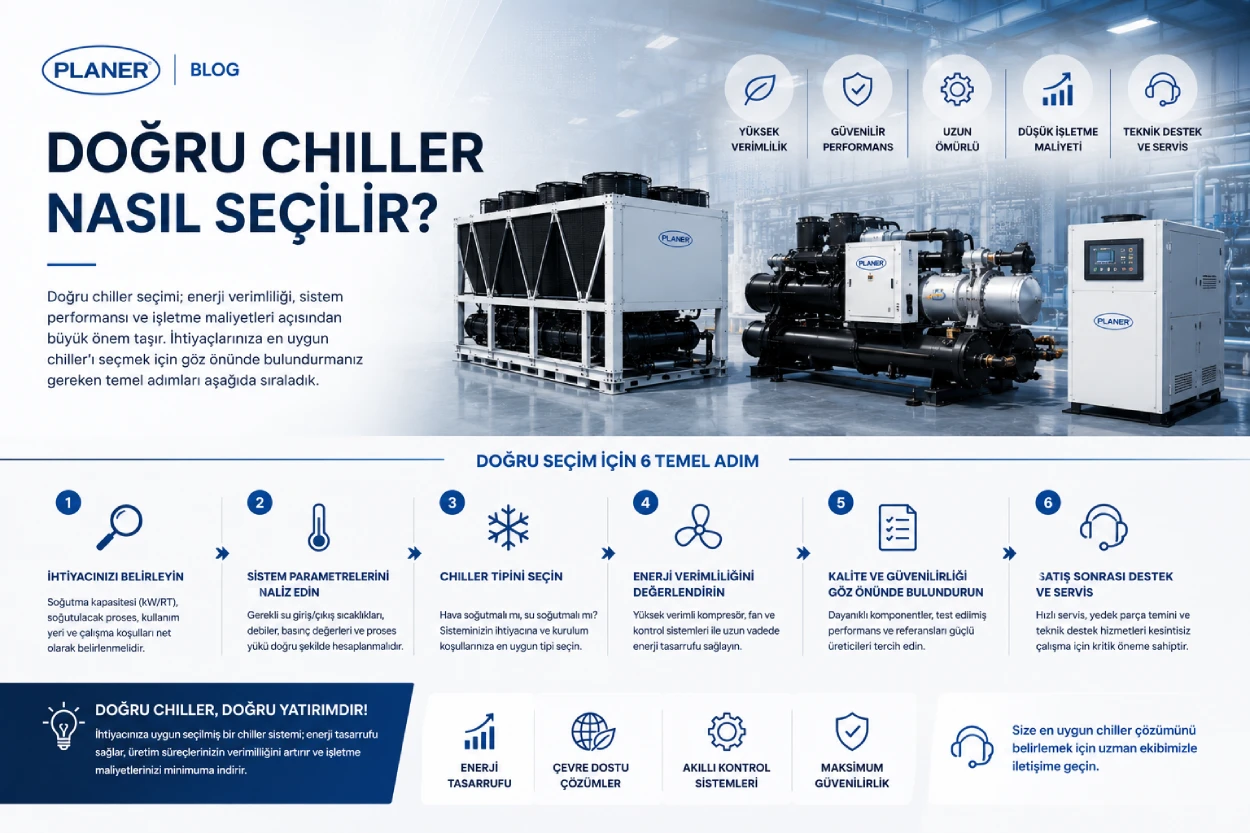
For a sound cooling load calculation, the following components must be determined separately and then added together:
- Process heat: the primary heat load that must be drawn from the mould, machine or reactor (kW).
- Pump heat: the mechanical energy the circulation pump transfers to the water — an item that should not be neglected in systems running continuously.
- Ambient gain: the heat that uninsulated tanks, pipes and lines pick up from a warm environment.
- Safety margin: typically a margin of 10-20% to account for fouling, condenser and evaporator performance decline, and future capacity increases.
Water temperature and ΔT: the heart of the cooling load calculation
The same kW value means a different chiller size and a different efficiency at different water temperatures. As the required chilled water outlet temperature drops, the compressor's operating conditions become harder and the effective capacity falls; for this reason a chiller's capacity must always be read against a specific water outlet temperature. A comparison made without translating the catalogue figure to your own operating temperature will be misleading.
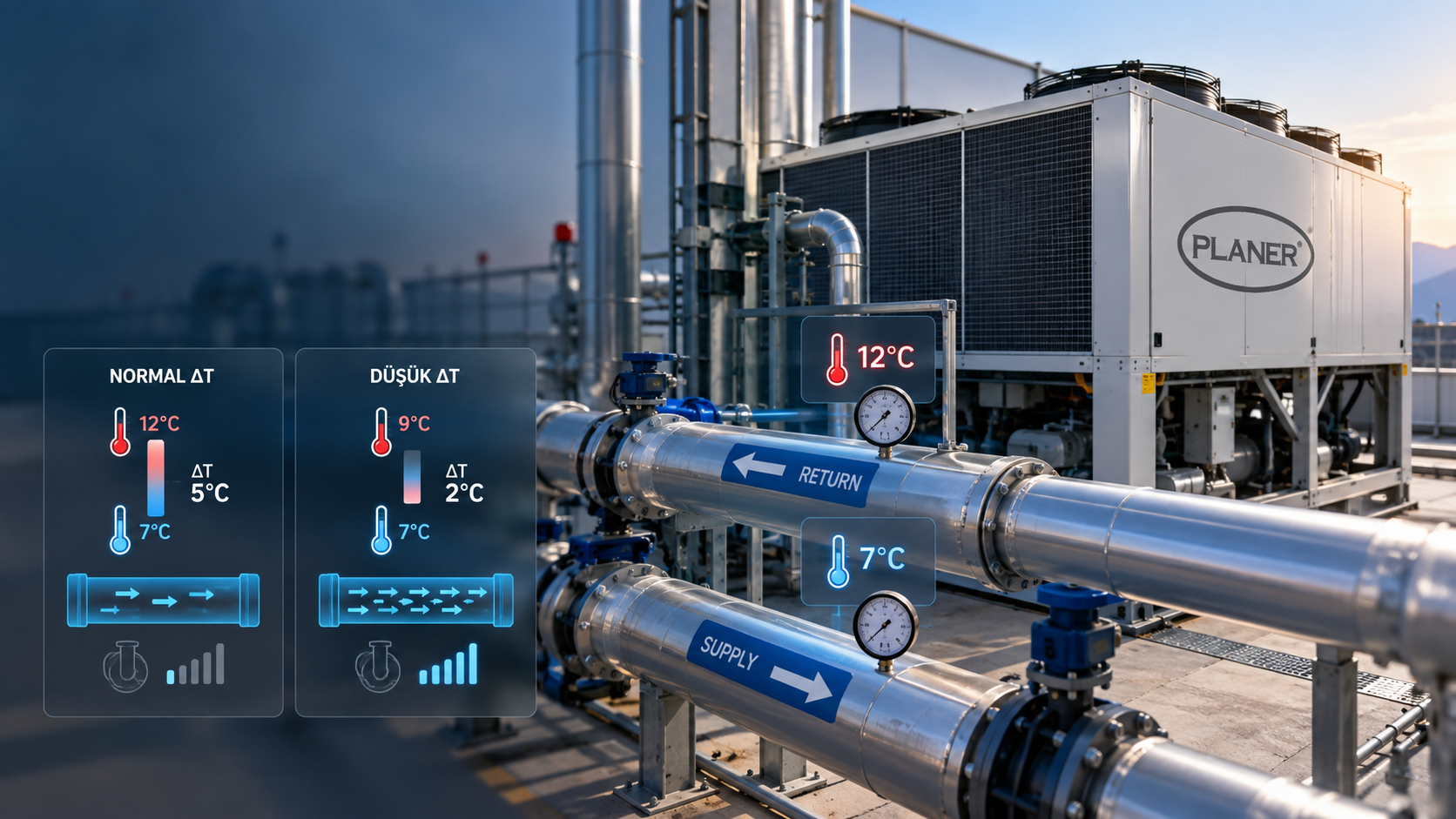
ΔT — the difference between the water's inlet and outlet temperatures at the chiller — determines both the flow rate and the system design. In most process applications a ΔT of around 5 °C is preferred. Cooling load is derived from the product of fluid flow rate and ΔT: a high ΔT means a lower flow rate and a smaller pump, while a low ΔT means a higher flow rate. Selecting the flow rate, ΔT and capacity so that all three are consistent with one another is decisive in establishing the correct chiller capacity.
Ambient conditions and refrigerant selection
A chiller's rated capacity is given for a specific ambient temperature. In summer, high outdoor air temperatures raise the condenser pressure in air-cooled systems and reduce the effective capacity. For this reason the capacity calculation must be based on the hottest design condition of your plant's region, and the unit should be planned for a location that is shaded, well ventilated and protected against hot-air recirculation.
The refrigerant is also a selection criterion. Planer chillers predominantly use R407C, while some models use R134a. The choice of refrigerant relates to the operating temperature range, efficiency and ease of servicing; the refrigerant decision should therefore be evaluated together with the target water temperature and the type of application.
Control accuracy, redundancy and glycol requirements
Some processes require water temperature held within ±1 °C, while others demand a far tighter band. Temperature stability directly affects product quality, cycle time and repeatability. In applications that need critical precision, buffer tank volume, proportional control and — where necessary — multiple compressor stages come into play. In plants where production must not stop, N+1 redundancy — planning one unit's worth of spare capacity beyond the requirement — safeguards continuity during maintenance and breakdowns.
The glycol/antifreeze decision, meanwhile, should usually be made at the selection stage rather than after the fact. Glycol is needed to protect against freezing at low water temperatures or in lines exposed to the outdoors. However, glycol changes the water's specific heat, viscosity and heat-transfer performance. This means the flow rate — and therefore the chiller size — must be revisited to meet the same load; a selection made without accounting for the glycol concentration will show up in the field as a capacity shortfall.
Common mistakes in chiller selection
Sizing errors usually stem from setting out with incomplete data. Paying attention to the following points prevents both undersized and oversized selections:
- Calculating only the process heat and overlooking pump heat and ambient gain.
- Reading the capacity at standard catalogue conditions instead of the plant's real operating water temperature.
- Basing the calculation on the average temperature rather than the local hottest design condition.
- Ignoring the effect of glycol use on flow rate and capacity.
- Oversizing with an excessive safety margin and losing efficiency and stability at part load.
- Failing to plan redundancy (N+1) in production that requires continuity.
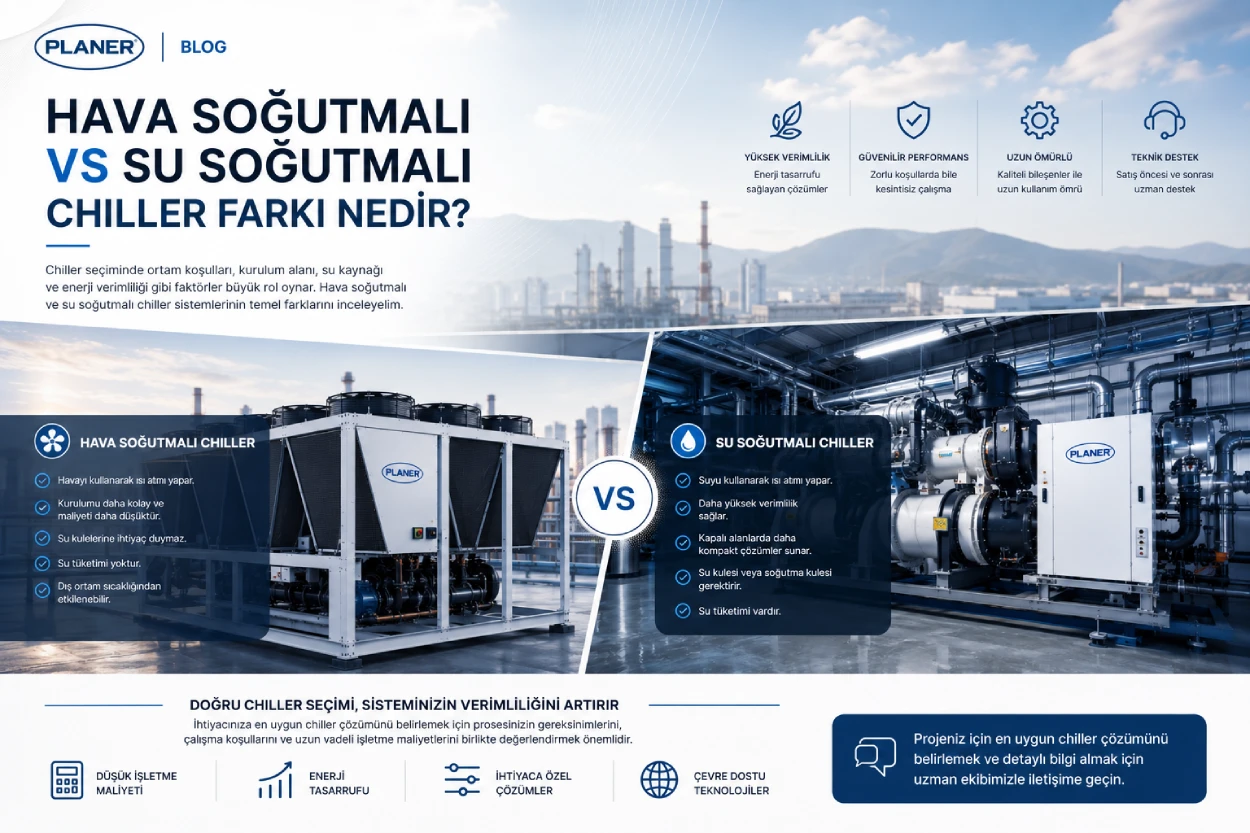
Choosing the right chiller rests on a rigorous cooling load calculation built from your site's real data. Planer manufactures air-cooled, water-cooled, dry cooler and hybrid solutions from roughly 16 kW up to 1,270 kW. To clarify the capacity, ΔT and refrigerant best suited to your application, you can contact Planer's engineering team and request a sizing assessment tailored to your plant.