The question of what a chiller is comes up for almost anyone dealing with temperature control in an industrial facility. In the simplest terms, a chiller is an industrial cooling unit that draws off the heat produced by a process or machine and removes it from the environment, thereby supplying chilled water (or a water-glycol mixture) at the desired temperature. Sitting at the heart of industrial water cooling and process cooling applications, this equipment moves heat from one point to another through the cycle of a refrigerant. In this article we explain, at a fundamental level and in engineering terms but plainly, what a chiller is, how the refrigeration cycle operates, and how a chiller works.
What a chiller is and what it does
A chiller is essentially a cooling machine: it takes in warm water returning from the process, extracts that water's heat through the refrigerant cycle, and sends the cooled water back to the process. The goal is to keep machines, molds, or products running at a stable, controlled temperature. When temperature is not held under control, product quality drops, cycle times lengthen, and equipment life is shortened.
The key difference between a chiller and a conventional cooling tower is that a chiller uses an active refrigeration cycle to bring water below the ambient temperature. For this reason, a chiller is often indispensable in process cooling applications that demand precise and repeatable temperatures.
How a chiller works: the refrigeration cycle
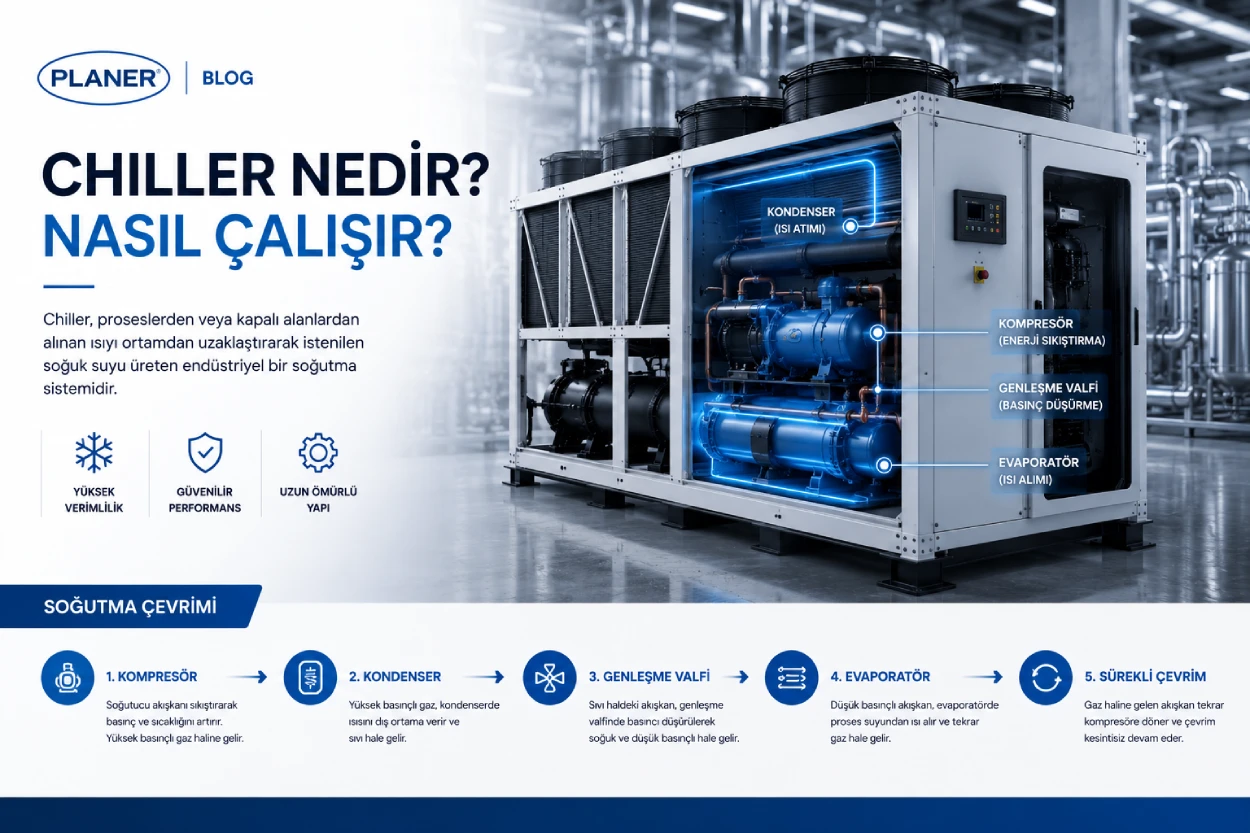
To understand how a chiller works, you need to grasp the refrigeration cycle — that is, how a refrigerant continuously changes state within a closed circuit to carry heat. The cycle revolves around four main components that, in turn, compress, condense, expand, and evaporate the refrigerant:
- Compressor: Compresses the refrigerant in its low-pressure gaseous state, raising its pressure and temperature; it is the component that actually drives the cycle.
- Condenser: Rejects the heat of the high-temperature gas to air or water, condensing the refrigerant into a liquid.
- Expansion valve: Sharply drops the pressure of the liquid refrigerant, turning it into a cold, low-pressure mixture ready to evaporate.
- Evaporator: The cold refrigerant absorbs heat from the water in the chilled-water circuit and evaporates; this is the point where the water is actually cooled. The vapor then returns to the compressor and the cycle starts over.
This four-step closed cycle repeats without interruption. Heat is transferred from the water to the refrigerant in the evaporator, and from the refrigerant to the outside environment (air or condenser water) in the condenser. In industrial chillers, the refrigerant carrying the cycle is most often R407C, and in some models R134a. The pressure difference between the expansion valve and the compressor determines the direction and efficiency of this heat transfer.
The chilled-water circuit and the process side
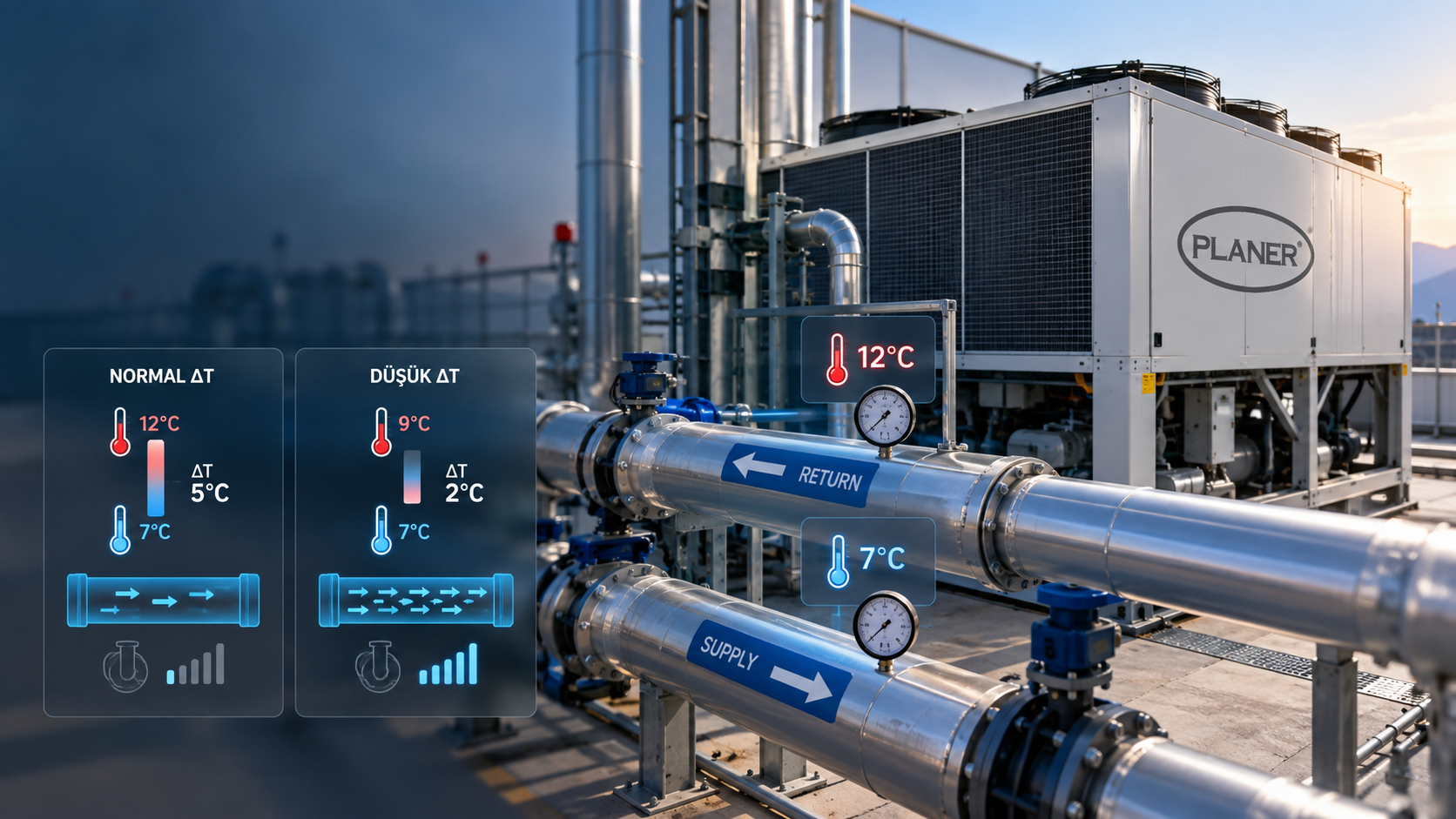
While the refrigeration cycle concerns the refrigerant, on the plant side it is the chilled-water circuit that does the actual work. The water cooled in the evaporator is sent by a pump to the molds, heat exchangers, or machines, where it absorbs the process heat, returns to the chiller warmed, and is cooled again. In this closed water circuit, the difference between the supply and return water temperatures — that is, the ΔT (delta-T) — is the fundamental quantity that shows how much heat the system is carrying.
In applications that require low temperatures or carry a freezing risk, a certain proportion of glycol is added to the water; this prevents the fluid from freezing but alters its heat-carrying capacity somewhat. Proper design of the chilled-water circuit, along with the choice of pump flow rate and ΔT, is just as important as the refrigeration cycle for stable and efficient chiller operation.
The main chiller types
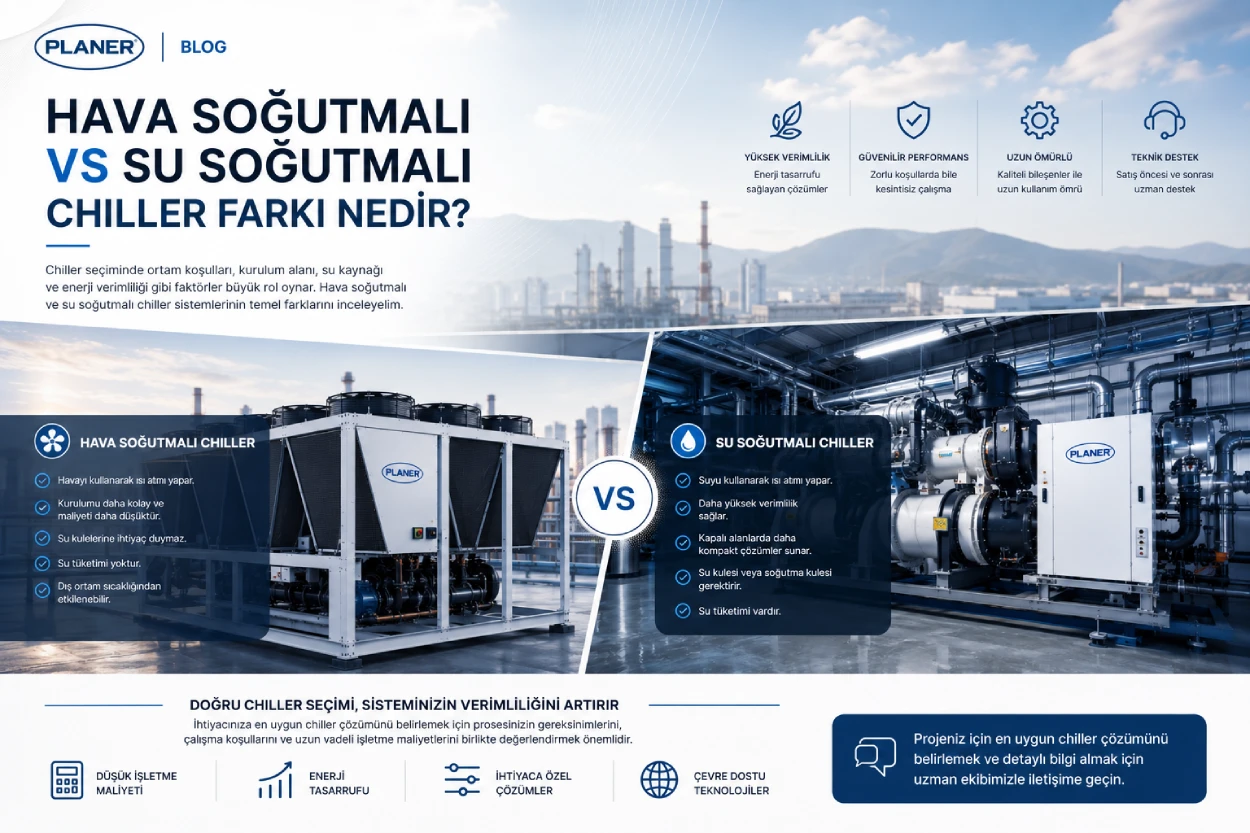
Chillers are divided into a few main groups according to the medium into which they reject condenser heat and their operating principle. Planer's product family also spans these fundamental types:
- Air-Cooled Chiller: Rejects the condenser heat directly to the air by means of fans. It requires no cooling tower; its installation and operation are relatively simple.
- Water-Cooled Chiller: Rejects the condenser heat to condenser water, which is usually cooled by a cooling tower. Suitable for high-capacity, continuously operating facilities.
- Dry Coolers: Cool the water or water-glycol mixture using air alone, without a mechanical refrigeration cycle; an economical solution under suitable outdoor conditions.
- Hybrid Chiller: Combines a mechanical refrigeration cycle with free cooling in a single system; when the outdoor air is cool enough, it reduces the compressor load and lowers energy consumption.
In the hybrid approach, under a suitable climate and low outdoor temperatures, free cooling kicks in and can deliver significant energy savings throughout the year. Which type is right depends on the process temperature, the capacity, and the climate where the facility is located.
Which sectors use chillers
Chillers are found in almost every branch of industry with a process cooling need. The common thread is the requirement to remove the heat a process generates in a controlled way and to keep the temperature stable. The leading areas of use are:
- Plastics: Mold and product cooling in injection and extrusion machines, and shortening of cycle times.
- Food and beverage: Process and product cooling on production and packaging lines.
- Metal: Equipment cooling in welding, casting, machining, and induction processes.
- Chemicals: Control of reaction temperature and process safety.
- General industry: A broad range of applications such as laser, printing, medical devices, and the like.
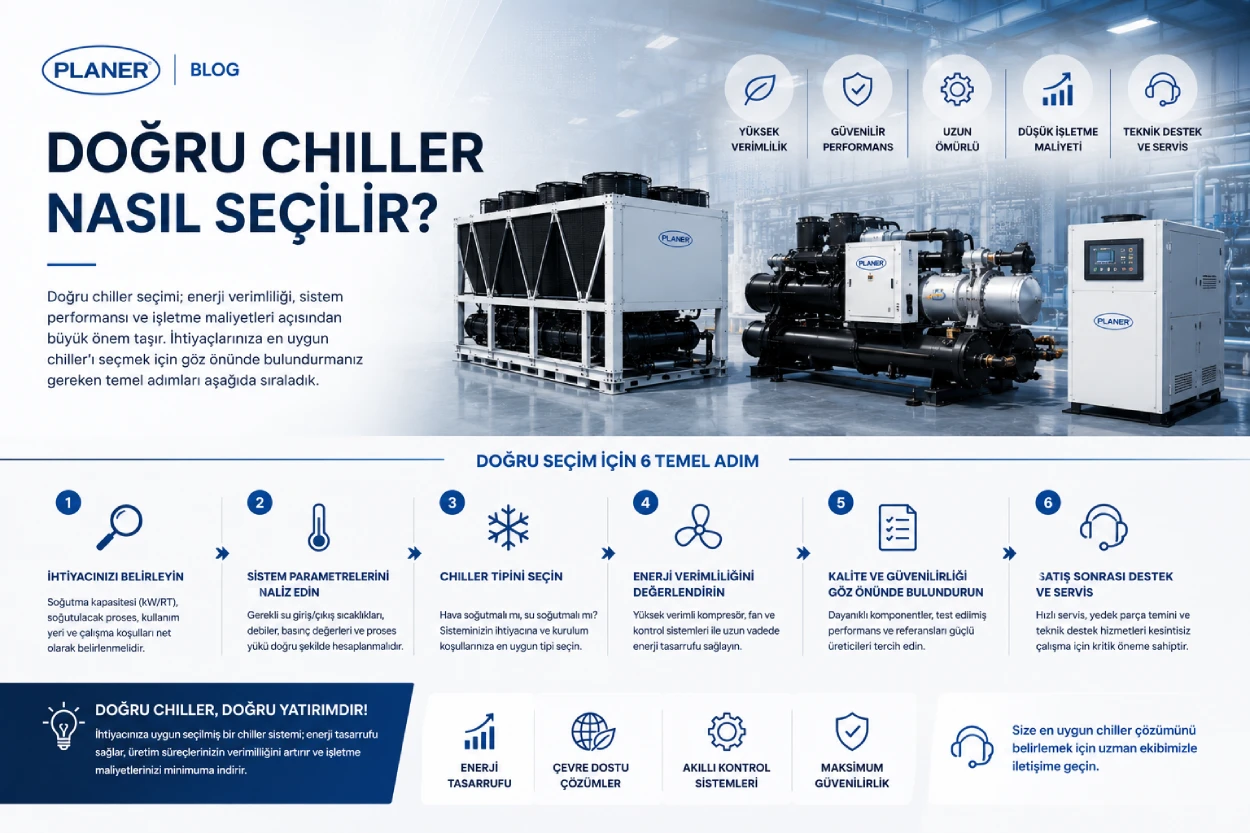
Understanding what a chiller is and how the refrigeration cycle operates is the first step in selecting the right system; capacity calculation and type comparison are separate topics of their own. To determine the chiller solution best suited to your application and to design your chilled-water circuit correctly, you can consult Planer's engineering team and request an assessment tailored to your needs.