A dry cooler is one of the simplest yet most widely misunderstood components in industrial cooling systems. A dry cooler is essentially a finned-tube coil that cools water, or a water-glycol mixture, using nothing more than ambient outdoor air driven across it by fans. It contains no refrigerant circuit, no compressor, and consumes no water; it rejects heat entirely within a closed loop, directly to the air. In this article we explain what a dry cooler is at the level of its design and working principle, clarify the difference between a dry cooler and a cooling tower, and pinpoint where the unit differs from a chiller.
What Is a Dry Cooler? Design and Components
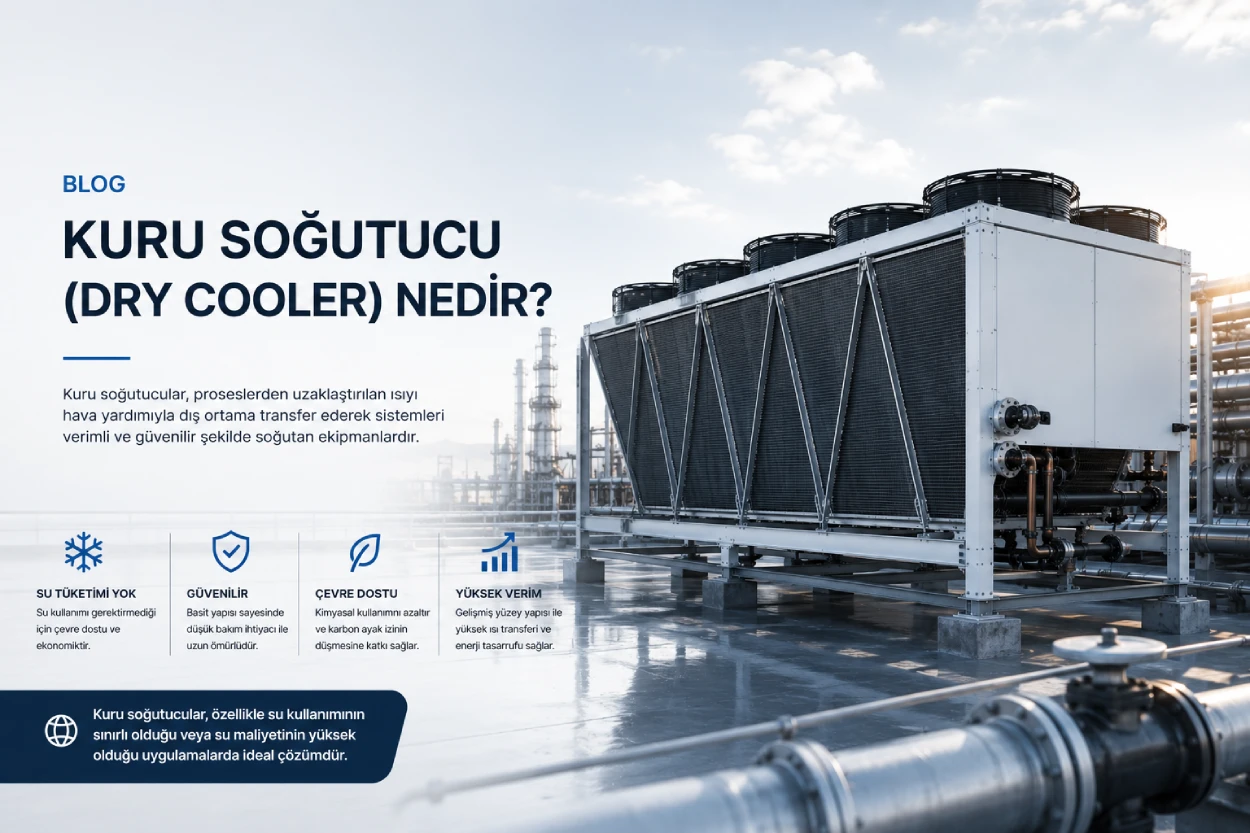
At its core, a dry cooler is a large air-to-liquid heat exchanger. Its heart is a finned-tube coil, made up of aluminum fins slid onto copper tubes. As the heated process fluid flows through this coil, forced air is passed over it, and the heat is carried into the air through the metal surfaces. The main components are the axial fans that move the air, the supporting frame (vertical, horizontal, or V-type construction), the collecting headers, and the fan-speed control.
The word "dry" in the unit's name marks a critical distinction: cooling takes place entirely through sensible heat transfer, meaning without any evaporation between the fluid and the air. The circuit is closed; the water or water-glycol mixture inside never contacts the outdoor air, so it does not become fouled and is not consumed. This makes the dry cooler a low-maintenance solution with no water costs.
The Working Principle of a Dry Cooler
The working principle of a dry cooler is thermodynamically straightforward. The fluid, heated by the process, is pumped to the coil. As the fans draw outdoor air across the coil, the fluid temperature drops, and the cooled fluid returns to the process. The lowest achievable fluid temperature depends directly on the outdoor dry-bulb temperature; in practice, the fluid can be cooled to within a few degrees above the ambient air temperature (the approach).
This dependency means that a dry cooler's capacity varies with the season and the time of day. Performance is high on cold days, whereas on hot summer afternoons the achievable fluid temperature rises. For this reason the fans are usually EC-motor-driven and variable-speed, keeping energy consumption and noise no higher than necessary while maintaining the target fluid temperature.
The Difference Between a Dry Cooler and a Cooling Tower
The most frequently confused topic is the difference between a dry cooler and a cooling tower. Both reject heat to the outdoor air, but their methods are fundamentally different. A cooling tower is an open system that cools by evaporating a portion of the water; thanks to this evaporation, the water can be brought down close to the outdoor wet-bulb temperature, but in return it continuously consumes water and requires make-up water, chemical treatment, and management of the Legionella risk. A dry cooler, by contrast, operates in a closed loop, through sensible heat transfer alone, without any evaporation.
- Water consumption: A cooling tower continuously uses water and needs make-up; a dry cooler consumes no water.
- Circuit type: A tower is generally an open circuit that brings the water into contact with the air; a dry cooler is a fully closed circuit.
- Achievable temperature: A tower approaches the wet-bulb temperature, whereas a dry cooler approaches the dry-bulb temperature.
- Maintenance and hygiene: A tower requires chemical treatment and biological risk management; a dry cooler requires none of these.
- Operation: In winter a dry cooler is protected against freezing with a water-glycol mixture, and managing the freeze risk is simple.
How It Differs From a Chiller and Where It Is Used
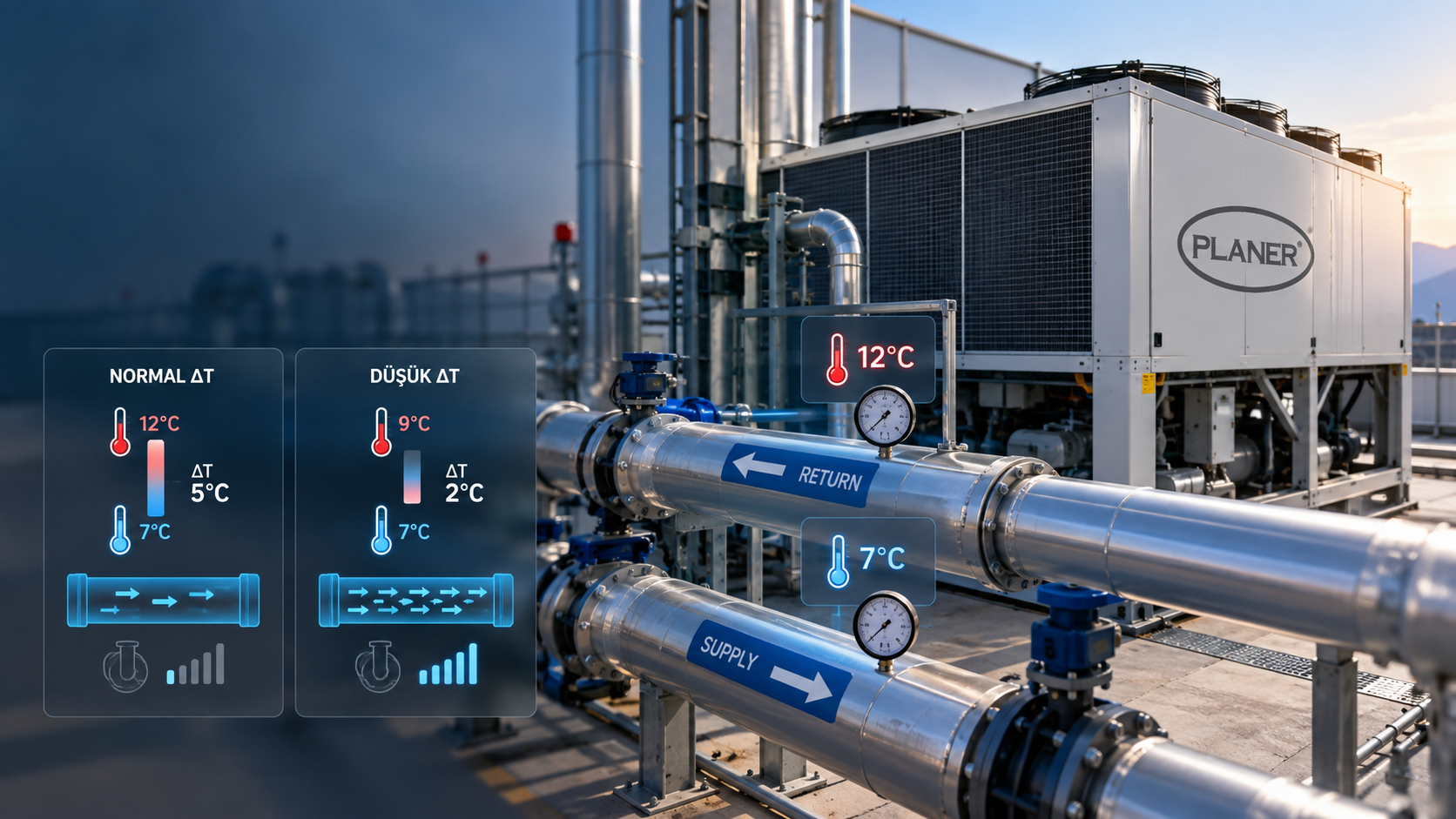
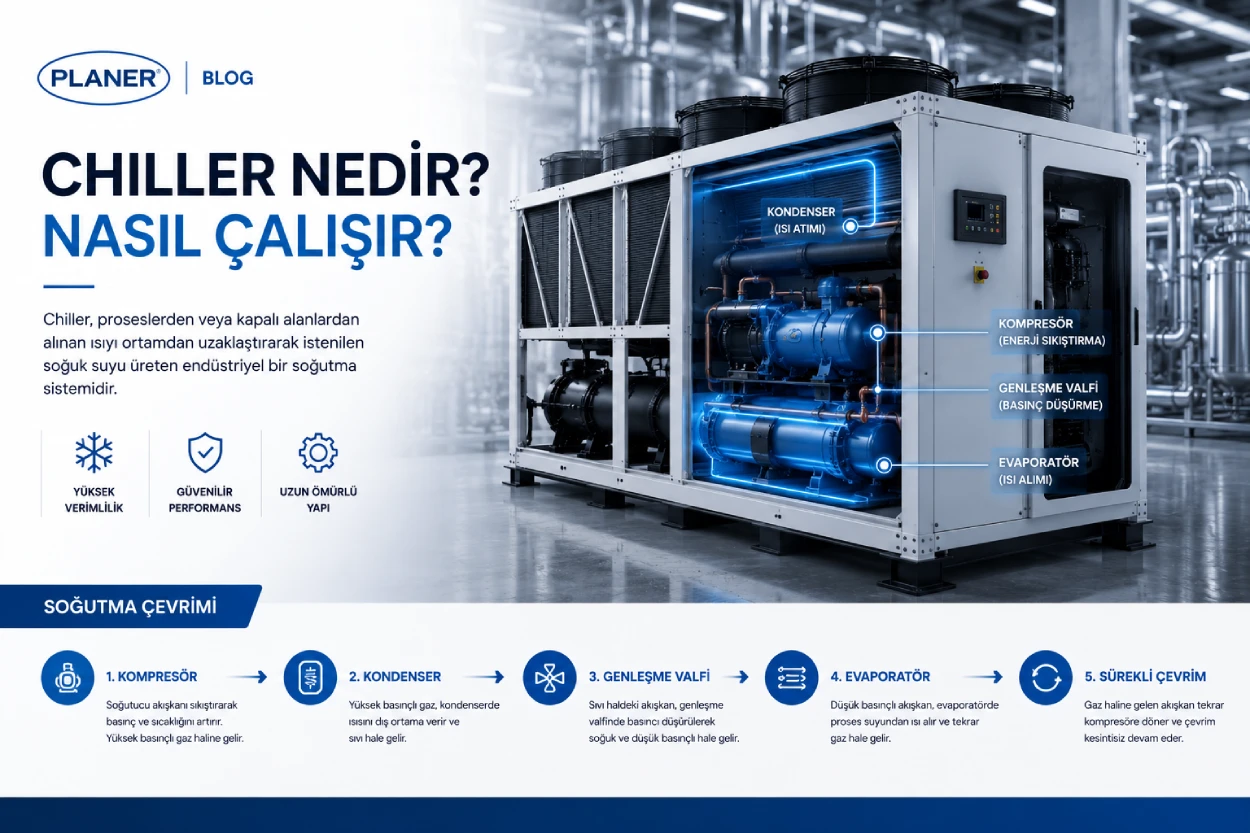
The fundamental difference between a dry cooler and a chiller is that the dry cooler contains no refrigerant circuit and no compressor. A chiller, through its compressor-condenser-expansion valve-evaporator cycle, can bring the fluid below the outdoor air temperature. A dry cooler cannot produce a temperature colder than the outdoor air; its real strength is that it does the work with the ambient air directly rather than with electricity, and thus consumes very little energy.
These characteristics define the typical applications of a dry cooler:
- Free cooling stage: When the outdoor air is cold enough, switching off the chiller's compressor and handing cooling duty over to the dry cooler.
- Cooling the condenser water in water-cooled chillers: Using a closed-loop dry cooler instead of an open tower.
- Direct process cooling: Feeding the process directly with the dry cooler when outdoor conditions are suitable.
An Adiabatic Cooler for Hot Days
The only limitation of a dry cooler is that its capacity depends on the outdoor air temperature. To overcome this limit, the adiabatic cooler (a dry cooler with evaporative pre-cooling) was developed. In adiabatic systems, the air entering the coil is first passed over wetted pads or misting surfaces and cooled by a few degrees through evaporation; in this way the air reaches the coil at a lower temperature and capacity is maintained at the summer peak.
Because the adiabatic stage is activated only during the hottest hours and only as much as needed, water is used only under peak conditions and in limited amounts. This largely preserves the dry cooler's low-water-consumption advantage while still delivering adequate performance in hot climates.
The Planer Dry Cooler product family, with its vertical, horizontal, V-type, and evaporative (adiabatic) variants, is manufactured to suit different flow-rate, temperature, and space requirements. To clarify which type and construction is right for your system, you can consult Planer's engineering and service team and determine the correct solution together, based on your process data.