One of the most critical decisions in any cooling project is choosing correctly between an air-cooled chiller and a water-cooled chiller. Both technologies do the same job: they produce chilled water by rejecting the heat drawn from the process to the surrounding environment. But the way they reject that heat — whether the condenser is cooled by air or by water — changes everything from installation to operating cost. Reading this fundamental distinction between chiller types correctly determines both the initial investment and years of running costs. In this article we compare the air-cooled versus water-cooled question through an engineering lens, and position the dry cooler and hybrid chiller as complementary options.
How air-cooled and water-cooled chillers differ
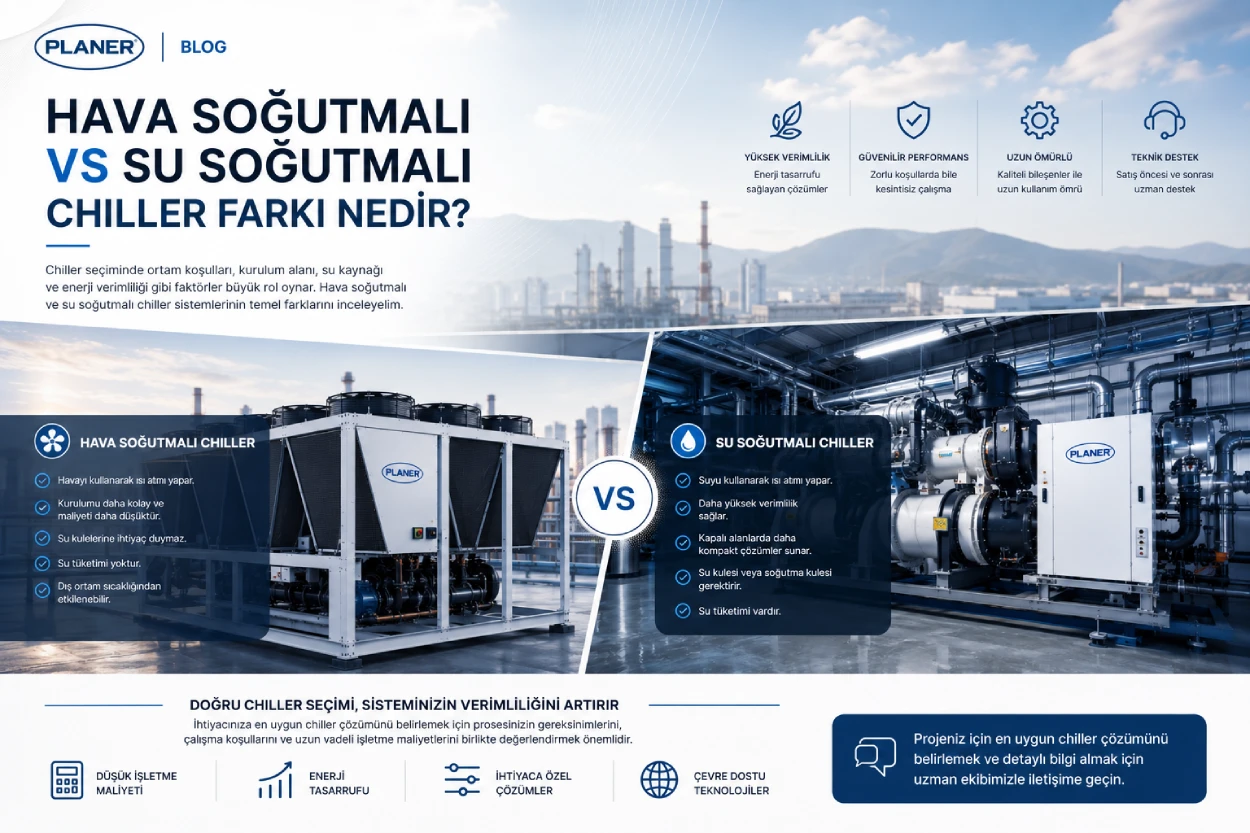
In an air-cooled chiller, the condenser is cooled by atmospheric air drawn across it by fans. The system is self-contained; it requires no external water supply and is generally installed on site as a single package. In a water-cooled chiller, the condenser is instead cooled by condenser water coming from a separate cooling tower or dry cooler. This means, in addition to the chiller, a water circuit, pumps and external heat-rejection equipment.
This distinction is not a technical detail; it is the difference at the root of the entire comparison. Rejecting heat to air versus to water directly affects everything from efficiency to space requirements, as covered in the sections below.
Installation, layout and space requirements
An air-cooled chiller is notably simpler in terms of installation. It is usually placed as a single unit on the roof, in an outdoor area or alongside the facility; there is no need to run a water line, build a tower or design a condenser pump set. This accelerates the project and reduces the engineering burden.
A water-cooled chiller, by contrast, requires a distributed layout: the chiller most often sits in the plant room while the cooling tower is located outside. Although the chiller body itself is relatively compact, the system as a whole — including the tower, piping and pumps — demands serious space and infrastructure planning. For facilities with limited outdoor space but available indoor room, this distributed arrangement can turn into an advantage.
Efficiency, COP and climate impact
Water-cooled systems typically reach higher COP values. Because the condenser water temperature can stay close to the outdoor wet-bulb temperature, the condensing pressure can be kept low; this means the compressor does less work. Especially in processes with high and continuous cooling loads, this efficiency gap becomes noticeable in operating costs.
The performance of an air-cooled chiller, on the other hand, depends directly on the dry-bulb temperature. In hot climates and during midday hours the condensing temperature rises and the COP drops somewhat. In mild and cool climates, however, this disadvantage shrinks; in winter, free cooling potential can also come into play. In short, climate is one of the decisive variables in the choice.
Water demand, cooling tower and maintenance
One of the most practical distinctions is water. A water-cooled chiller continuously consumes water in the cooling tower through evaporation and blowdown, and this water must be treated. The tower and condenser circuit bring a regular chemical and mechanical maintenance load to operations. An air-cooled chiller eliminates most of this burden.
- Water-cooled chiller: continuous water consumption, water treatment and tower maintenance; regular water-chemistry monitoring is required to guard against scale, corrosion and Legionella risk.
- Air-cooled chiller: water consumption is negligible; the main maintenance involves the fans, fin cleaning and keeping the condenser coil free of dust.
- In regions with water restrictions, high water costs or difficult water allocation, the air-cooled solution is often the only realistic option.
- In facilities with heavy, continuous loads and suitable water infrastructure, the efficiency advantage of the water-cooled solution comes to the fore.
Initial investment and operating cost
In terms of initial investment, the air-cooled chiller is generally more advantageous, because there is no cost for a tower, condenser pumps or water infrastructure; installation is also faster and simpler. In a water-cooled system, even though the chiller unit itself is relatively affordable, the tower, pumps and piping drive the total investment upward.
When it comes to operating cost, however, the picture can work in the opposite direction. The high COP of a water-cooled system delivers meaningful savings on the energy bill during continuous, high-hour operation; but to this you must also add the cost of water, water-treatment chemicals and tower maintenance. The right decision is made not on the sticker price alone, but by looking at the process's annual operating profile and at local energy and water prices.
Dry cooler and hybrid chiller: complementary options
The comparison is not limited to just two options. A dry cooler cools the water coming from the process directly with atmospheric air, without evaporation; it consumes no water and, at suitable outdoor temperatures, offers the ability to reject heat with free cooling alone, without ever running the compressor. This translates into significant energy savings, particularly during cool seasons.
A hybrid chiller, in turn, combines mechanical cooling and free cooling in a single system: when the outdoor air is cool enough, free cooling takes over, and the compressor tops up when needed. This way, the water independence of the air-cooled solution and the efficiency of free cooling are achieved together. Under suitable conditions, serious reductions in annual energy consumption are possible.
Which one for which process
To give general guidance: for facilities in mild climates or with variable loads, where water infrastructure is limited and where installation speed and maintenance simplicity matter, an air-cooled chiller is a strong option. For processes with high and continuous cooling loads, a suitable water source and a plant room available, and where energy efficiency is prioritized, the water-cooled chiller stands out. For facilities that want to keep water consumption near zero while also benefiting from free cooling, the dry cooler and hybrid chiller should be evaluated.
Planer manufactures its entire range of air-cooled chillers, water-cooled chillers, dry coolers and hybrid chillers under one roof, which makes it possible to base the decision on the process rather than the product. To pin down the configuration best suited to your process's load profile, climate conditions and infrastructure, you can start by speaking with Planer's engineering team.