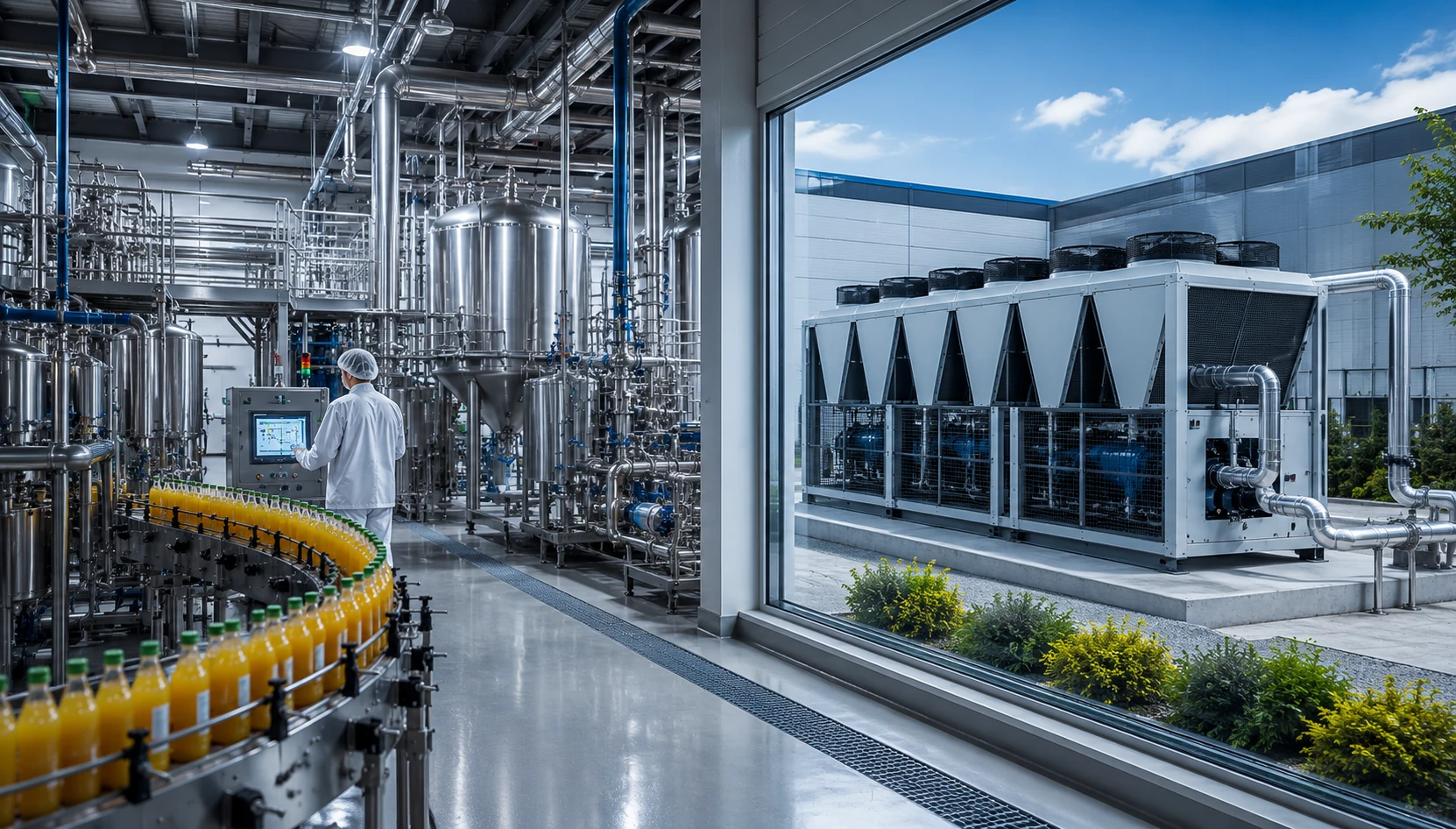
Food industry cooling is one of production's invisible yet most decisive engineering layers, because a product's flavor, texture, shelf life, and food safety often hinge on controlling temperature at the right moment and the right value. Food process cooling should not be equated with cold storage alone: at critical points such as rapid pull-down after cooking, holding fermentation temperature steady, post-pasteurization cooling, and conditioning the filling line, the food chiller solutions that come into play run at the very heart of the production line. In this article we examine beverage cooling and general process chiller applications through the distinctive hygiene, stability, and continuity requirements of food and beverage manufacturing.
Why is food process cooling so critical?
In food and beverage production, temperature is the first line of defense for microbiological safety. The shorter the time a heat-treated product spends in the danger temperature zone, the lower the risk of microbial growth; rapid cooling after cooking and pasteurization is therefore not a convenience but a quality and food-safety imperative. That same temperature control also determines a product's physical properties: a sauce or jam cooled quickly and under control holds its intended consistency, whereas a product cooled without control can show phase separation, crystallization, or textural breakdown.
On the beverage side the picture is even more delicate. Because carbon dioxide solubility in carbonated drinks depends directly on temperature, keeping the product at a low and stable temperature before filling both retains the gas in the product and lets the filling line run steadily without foaming. At these points the benchmark should be temperature stability, not raw capacity.
Critical process points: where does the chiller come in?
In food and beverage plants the chiller load is never concentrated at a single point; it is the shared backbone of processes with widely differing characteristics. Typical points of use can be listed as follows:
- Moving product rapidly out of the danger temperature zone after cooking and blanching
- The controlled cooling stage that follows the heating section on a pasteurization line
- Holding temperature within a narrow band via jacket cooling on fermentation and proofing tanks
- Conditioning product and equipment on mixing, emulsification, and filling lines
- Cooling the condenser and process water in vacuum, extraction, and concentration processes
- Tank and coil cooling on lines such as jam, chocolate, and dairy products
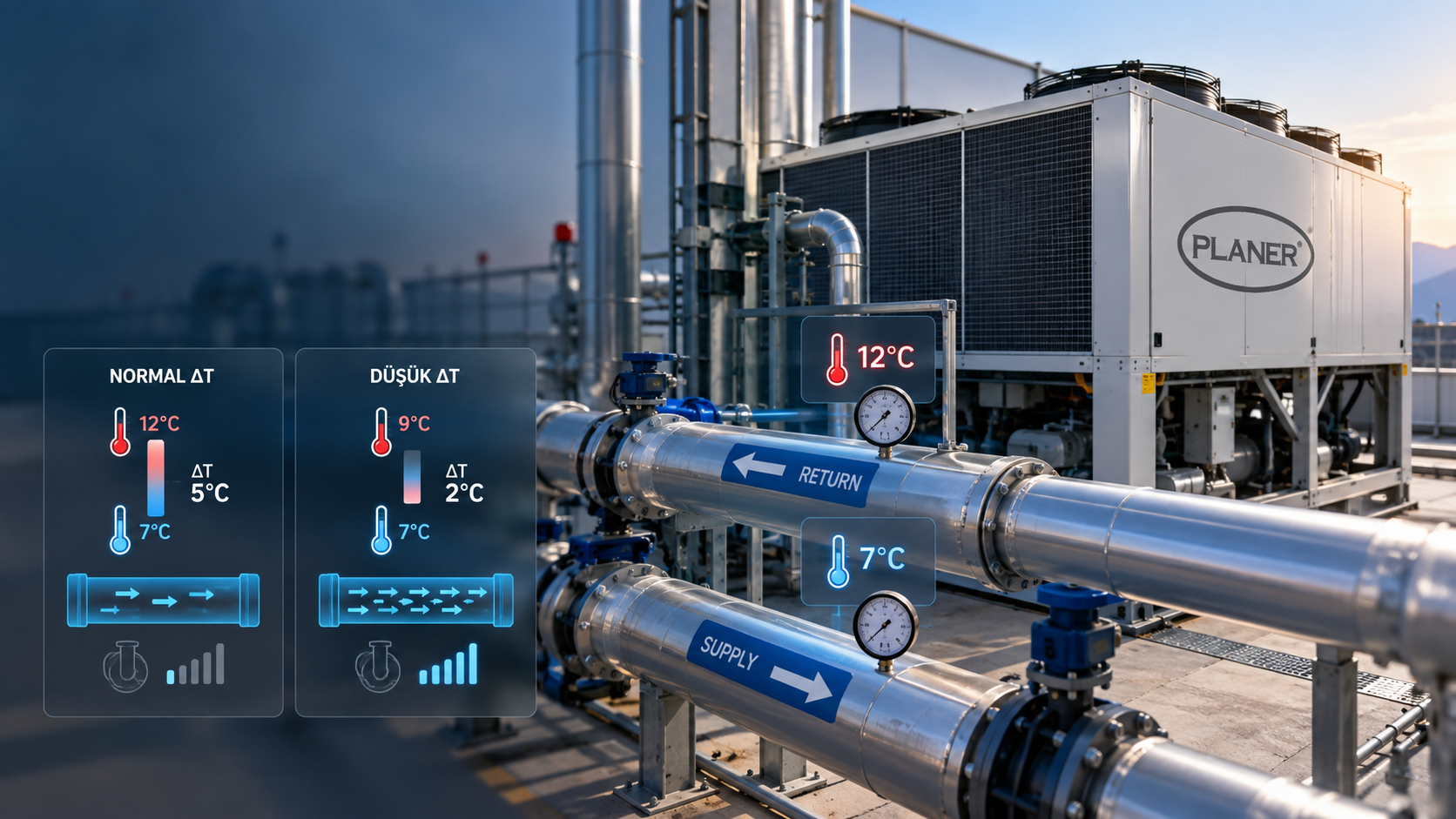
What all these varied loads share is, in most cases, a demand for low and extremely stable chilled water or a water-glycol mixture. Because in some processes, such as fermentation, even a deviation of a few degrees can shift the product profile, the chiller's ability to suppress fluctuation matters as much as its ability to meet the load.
Hygienic design and correct material selection
On lines in food contact, or close to it, the chiller system must integrate with hygienic design principles. On the heat-exchange surfaces in direct contact with the product and in the chilled-water circuits, stainless steel and food-grade materials are preferred; a line layout that minimizes dead volumes, uncleanable corners, and areas prone to buildup is essential. A closed-loop chilled water/glycol system safely separates the product from the refrigerant, both reducing the risk of cross-contamination and preserving the cleanliness of the process water.
Material selection is a matter not only of hygiene but also of continuity. The CIP (clean-in-place) cycles commonly run in food plants use hot water, steam, and chemicals; the process cooling circuit must be designed to be compatible with these cycles, corrosion-resistant, and non-disruptive to the cleaning schedule.
Temperature stability, traceability, and food safety
Success in food process cooling is measured not by reaching a single set point but by holding that temperature within a narrow band over time. A system that quickly recovers the water temperature when the load changes abruptly, and that runs with low fluctuation, delivers both repeatability in product quality and process safety. For this reason, in food applications, low and stable water temperatures are often more valuable than a wide capacity.
In modern food production, temperature is also a matter of record. Continuously measuring, logging, and, when required, retrospectively demonstrating the cooling temperatures at critical control points is the foundation of traceability, both for internal quality systems and for audits. It is therefore sound practice to conceive process chiller solutions with a control infrastructure that can export temperature data and integrate with plant automation.
Continuity, redundancy, and energy in a food industry cooling system
Most food and beverage plants operate continuously or in long shifts; a cooling failure not only halts production but can also jeopardize the safety of finished product and the batch in progress. For this reason, on critical lines, redundant architectures built with multiple compressors or several units are preferred over a single large machine, so that production can continue, even at reduced capacity, when one component drops out. Such a layout also allows planned maintenance to be carried out without stopping production.
On the energy side, food plants generally cool year-round and at high operating hours; this makes part-load efficiency, the right condenser type, and the correct configuration for ambient conditions economically decisive. The goal is a balanced design that keeps operating costs reasonable without compromising food safety.
Cooling in food and beverage production is a precise engineering field where product quality meets food safety; hygienic design, stable water temperature, and redundant continuity must be considered together. For Planer's air-cooled, water-cooled, and hybrid chiller solutions and dry coolers aimed at the food and beverage sector, you can consult Planer's engineering and service team to jointly define a layout suited to your plant's process points.