For industrial facilities seeking chiller energy savings, free cooling is one of the most tangible ways to permanently lower operating costs. Over a chiller's total lifetime cost, the electricity drawn by the compressors often far exceeds the purchase price. Free cooling targets exactly this item by shutting the compressors down, or reducing their load, to reject heat whenever the outside air is cool enough. In this article we take an engineering look at how free cooling works, the logic behind hybrid chillers, and the conditions in which the savings pay back the fastest.
How free cooling works
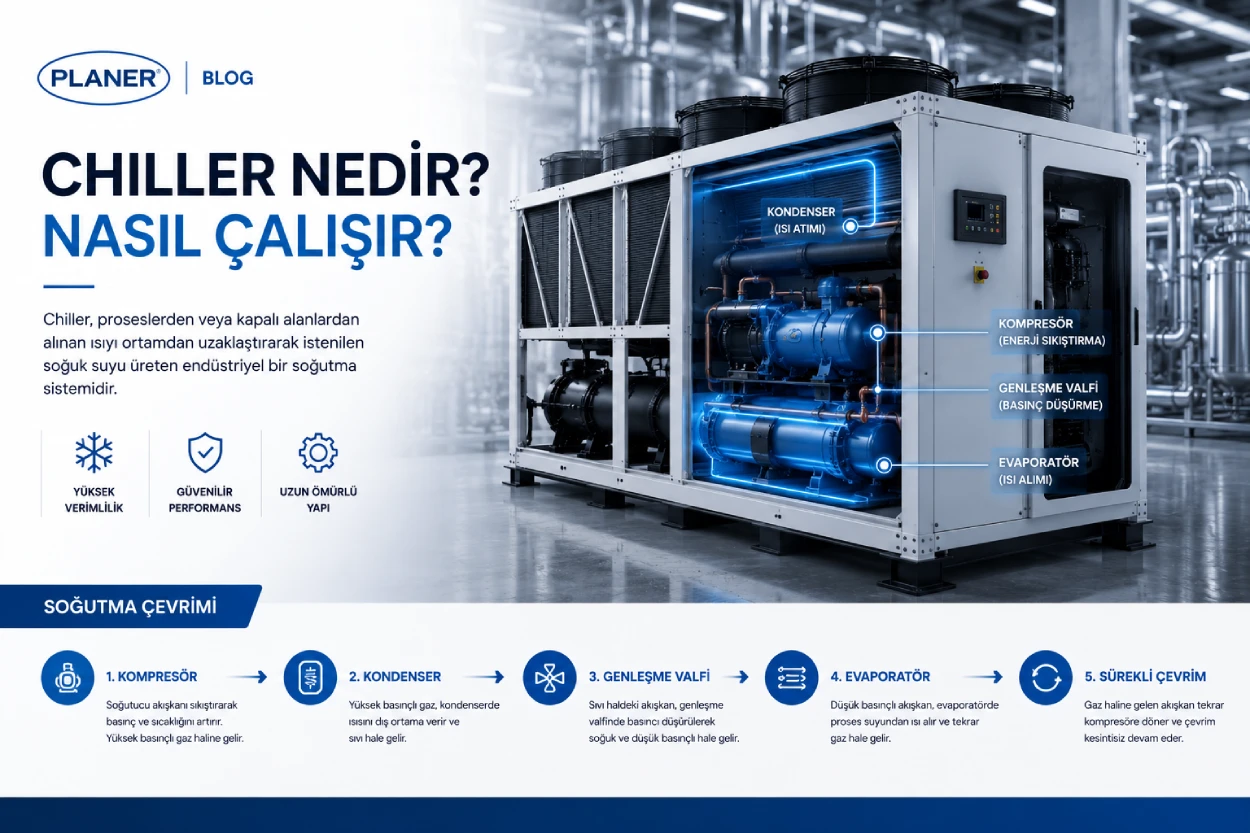
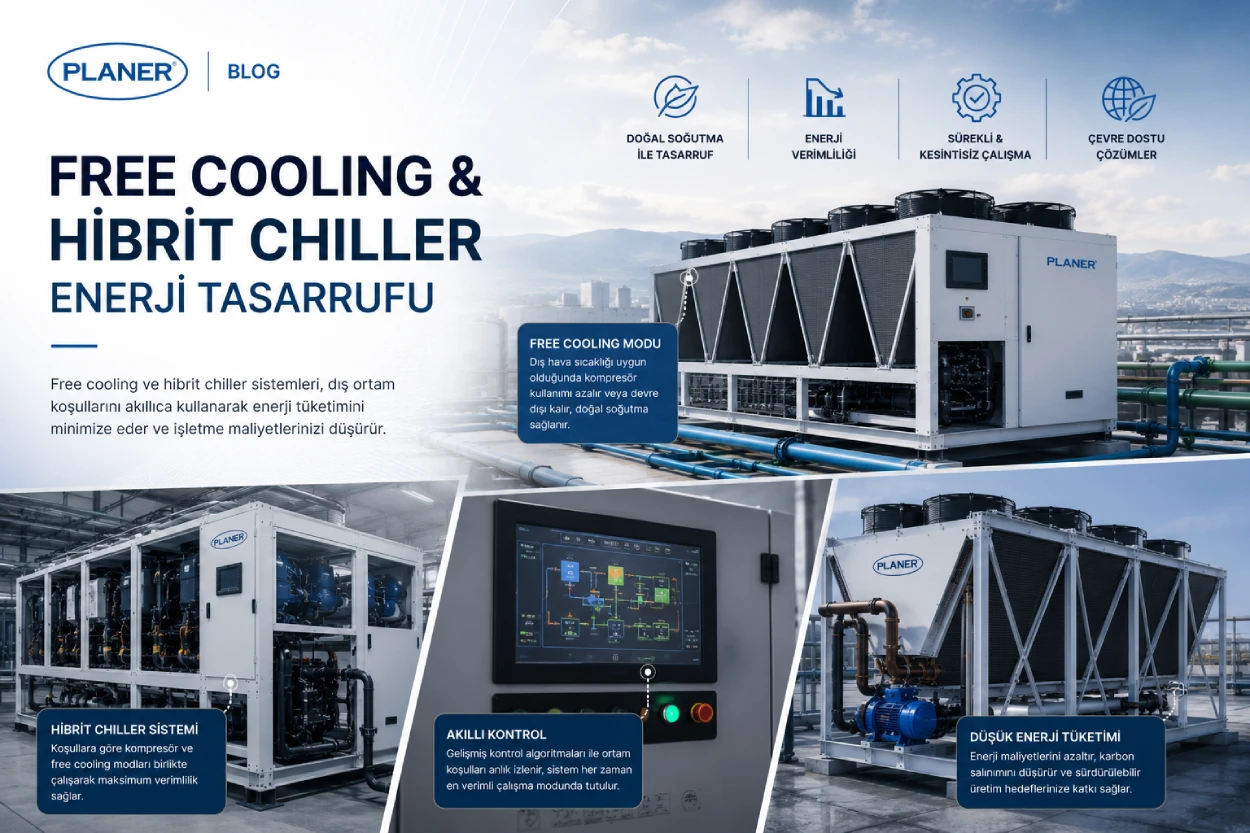
In a conventional refrigeration cycle, the cooling load is rejected through the compressor that pressurises the refrigerant, and this is precisely where most of the electricity is consumed. With free cooling the logic is reversed: when the outside air temperature drops far enough below the returning chilled-water temperature, a free cooling coil or a dry cooler added to the system comes into play. This coil delivers the warm water returning from the process directly to the outside air, rejecting some or all of the heat without the compressor running.
The decisive parameter is the temperature difference between the outside air and the chilled water. Partial free cooling begins once the outside air falls a few degrees below the target water temperature; as the difference widens, the coil rejects more heat and the compressors shed load in stages. When the air cools further, the system switches to full free cooling mode: the compressors stop entirely and only the pumps and fans keep running. The electricity drawn then falls to a much smaller fraction compared with mechanical cooling.
Hybrid chiller: chiller and free cooling in a single body
A hybrid chiller is a solution that combines the mechanical refrigeration cycle and the free cooling coil in a single unit. Instead of installing a separate dry cooler alongside a separate chiller, both modes coexist within one body, and the control system switches automatically according to the load and outdoor conditions. For most of the year the system runs in one of three modes: full mechanical cooling on hot days, a partial mode in which the compressor and the coil work together during the transition seasons, and compressor-free full free cooling on cold days.
This staged arrangement significantly reduces compressor running hours throughout the year while keeping the facility's chilled-water temperature on target. Fewer compressor hours benefit not only the energy bill but also maintenance intervals and mechanical wear, all of which feed into the total chiller operating cost.
Where the savings pay back the fastest
Free cooling does not pay back the same way at every facility; the gain is directly tied to the operating profile and the climate. The typical conditions under which the investment returns fastest are the following:
- Year-round, uninterrupted or multi-shift cooling loads; the more running hours, the wider the free cooling window.
- Mild or high chilled-water temperatures; for example, if the process can operate with 12-18 °C water, free cooling engages for a far longer portion of the year.
- Cool climates or those with long transition seasons; in regions where low outdoor temperatures are common, full free cooling hours multiply.
- Glycol-dosed circuits; thanks to freeze protection, the system can safely benefit from free cooling even at low outdoor temperatures.
- Facilities with a high electricity unit price; every hour the compressor is avoided translates directly into savings.
Conversely, in a process that runs only during the summer months and with very low water temperatures, the free cooling window is narrow and the payback is longer. For this reason the decision should be made on the basis of the facility's real load curve and the temperature distribution of its climate.
Realistic savings and payback expectations
The annual gain from free cooling is proportional to the number of hours the compressors are taken offline. With suitable chilled-water temperatures and a cool climate, savings of up to 40% in annual cooling energy can reasonably be discussed under favourable conditions; however, this figure varies considerably depending on the climate, the load profile, and the selected water temperature. Rather than quoting a single exaggerated number, the correct approach is to carry out a facility-specific hour-based temperature distribution (bin-hour) analysis.
The payback period depends on the same variables. In facilities with high running hours and a high energy unit price, the additional investment in a hybrid solution returns relatively quickly, whereas in low-usage facilities the period lengthens. The decision should therefore rest on a measurable calculation rather than a standard promise.
Planer Hybrid Chillers and Dry Coolers
Planer's Hybrid Chiller and Dry Cooler product families are designed to integrate free cooling into the process cooling system. It is possible either to add a dry-cooler-based free cooling stage to an existing chiller system or to opt for a hybrid unit from the outset; the right choice is determined by the facility's chilled-water temperature, load curve, and climate.
If you would like to see the realistic savings and payback period that free cooling could deliver using your facility's load profile and climate data, Planer's engineering team is ready to assess the right hybrid configuration together with you.