At the heart of every chiller lies a component that is invisible yet critical to how the system cools: the chiller refrigerant. Commonly referred to as the chiller gas, this fluid evaporates at low pressure in the evaporator to draw heat out of the process, then condenses at high pressure in the condenser to release that heat outside. In other words, the material that directly determines a unit's cooling capacity, efficiency and operating temperature range is the chosen refrigerant itself. In this article we look, from an engineering perspective, at the role of common fluids such as R407C and R134a, at the concept of GWP, and at how the F-Gas regulation is transforming the industry.
The Core Function of a Chiller Refrigerant
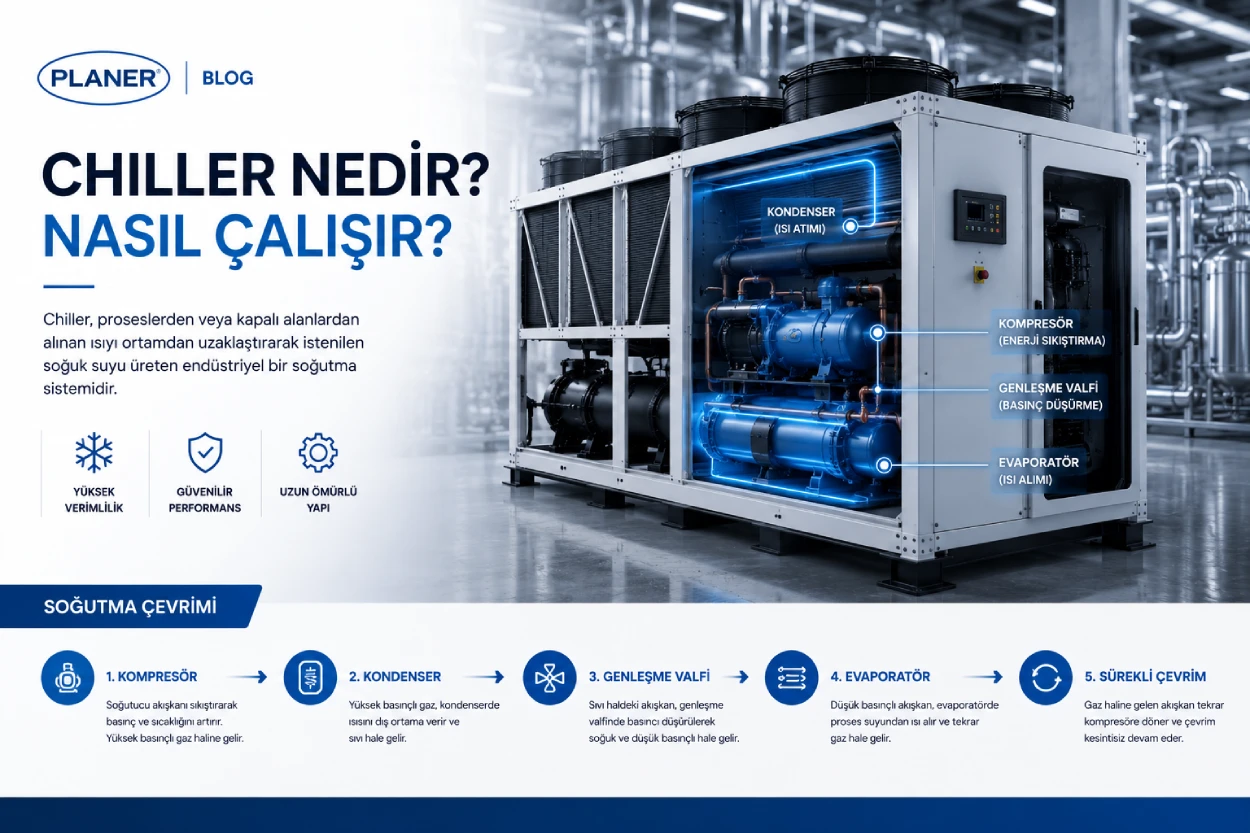
A refrigerant is the working fluid that carries heat from one point to another by changing phase within the chiller's closed circuit. In the evaporator it absorbs heat from the chilled water or the process and evaporates; the compressor then compresses it, raising its pressure and temperature; in the condenser it condenses and rejects that heat to the air or to the condenser water. We won't rehearse the cycle itself again here; what matters is that the fluid's thermodynamic properties dictate the evaporation and condensation temperatures at which the unit will operate efficiently.
For this reason, no single fluid is ideal for every application. Each refrigerant, differing in its chemistry, has its own pressure-temperature curve, saturation points and condensation-temperature limits. Choosing the right fluid is decisive for capacity, energy efficiency (COP/EER) and the long-term, stable operation of the unit.
R407C: A Common, General-Purpose Chiller Gas
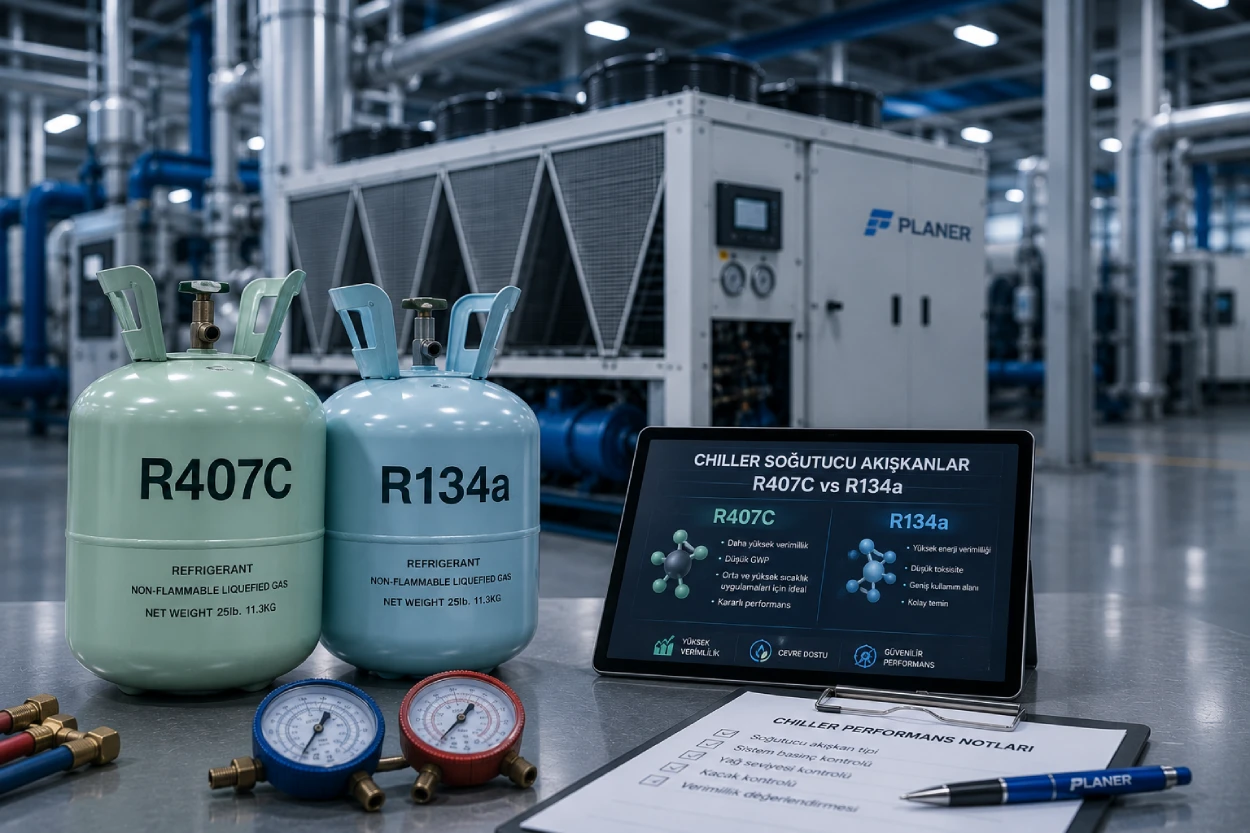
R407C is a general-purpose refrigerant blend that has been a preferred choice in industrial and commercial cooling for many years. Its balanced performance across a wide range of capacities and temperatures has made it a common standard in both air-cooled and water-cooled chillers. It comfortably meets the expected operating conditions of the great majority of air-conditioning and process-cooling applications.
Because R407C is a zeotropic blend, it exhibits a slight temperature shift (glide) during the phase change. This is a practical detail that must be accounted for in system design and, especially, during servicing, where the fluid must always be charged from the liquid phase. Applied correctly, however, it is a reliable, predictable and readily available solution.
Where Does R134a Come Into Play?
R134a is a single-component (pure) refrigerant that stands out particularly in applications involving high condensation temperatures or specific compressor types. Its stable operation at high ambient temperatures or under hot-water/high-condensation conditions makes it a suitable option for certain chiller models.
In practice, refrigerant selection is directly tied to the temperature regime the application demands, the compressor technology and the capacity range. Even within the same product family, it is normal for different fluids to be preferred depending on the targeted operating point. The refrigerant should therefore be considered a design decision, weighed together with the model.
GWP and the Trend Driven by the F-Gas Regulation
The environmental impact of refrigerants is measured by their GWP (Global Warming Potential). When high-GWP fluorinated gases escape into the atmosphere, they contribute to global warming far more powerfully than carbon dioxide. It is precisely for this reason that the European Union's F-Gas regulation aims to phase down high-GWP fluids and drive the transition to low-GWP alternatives. In many markets, including Turkey, the industry is changing direction in response to this regulatory pressure.
Within this trend, we summarise below a few of the low- and medium-GWP alternatives frequently mentioned in the sector, purely as a reflection of a general industry direction:
- R513A — kept on the agenda as a lower-GWP alternative noted for behaving similarly to R134a.
- R1234ze — an HFO-class, very-low-GWP fluid being evaluated for certain chiller applications.
- R32 — an option offering lower GWP than R410A, becoming widespread particularly on the air-conditioning side.
Since some of these fluids may fall into the mildly flammable (A2L) class, they bring additional design, ventilation and safety requirements. These names are given here only to illustrate the sector's direction; they do not imply use in any specific product.
Practical Takeaways: Leak Detection and Service
Whatever fluid is used, the most tangible reflection of F-Gas legislation appears in field practice. In systems containing high-GWP fluids, periodic leak detection, record-keeping and service by qualified personnel are becoming increasingly important. A leak is not only an environmental burden; it also means lost capacity, reduced efficiency and a higher risk of failure.
For this reason, the following points are decisive in the field:
- Correct charge quantity during commissioning and maintenance, with the fluid loaded from the liquid phase.
- Regular leak checks at connections, welds and gasket points.
- Verification that the fluid is suitable for the application and its operating temperature.
- Recovery of the refrigerant during servicing and its regulation-compliant disposal or reclamation.
The fluid's relationship to the application must not be overlooked either: low-temperature processes may call for a glycol mixture and different fluid behaviour, while high ambient temperatures put the condensing side under strain. The right fluid-to-application match protects both efficiency and operational safety.
Refrigerants Used in Planer Chillers
Planer chillers predominantly use R407C; in certain models, R134a is preferred depending on the conditions the application requires. This choice is made to suit the unit's targeted capacity range, temperature regime and operating conditions. In this period, as the industry evolves toward low-GWP fluids, sound leak management and maintenance discipline are just as decisive for efficiency over the product's lifetime as the choice of fluid itself.
Which refrigerant best suits your application depends on your operating temperatures and process conditions. For the right fluid selection, leak detection and service planning, you can consult Planer's engineering and service team to determine together the solution that best fits your needs.