The heart of a chiller is its compressor; it is the component that largely determines the system's efficiency, sound level, vibration behaviour, and long-term maintenance cost. Choosing the right one among the available chiller compressor types is not simply about meeting a cooling capacity — it is about matching the technology to your facility's load profile, operating hours, and acoustic expectations. In this article we compare scroll, screw, and reciprocating compressors from an engineering standpoint, using practical criteria such as capacity range, part-load efficiency, noise, and maintenance.
Why does chiller compressor selection determine performance?
The compressor is the active component that drives the refrigeration cycle by compressing the refrigerant from low pressure to high pressure, and it accounts for the largest share of the electrical energy the system consumes. As a result, the compressor technology feeds directly into the COP and EER figures — that is, into how much cooling you get for every kW of electricity you spend.
The real difference, however, emerges not at full load but at part load. Industrial chillers spend most of their time running below full capacity, which is why the compressor's capacity-control method — whether it is stepped or continuous — becomes the decisive factor in annual energy consumption.
Scroll compressor: quiet and reliable at small-to-medium capacity
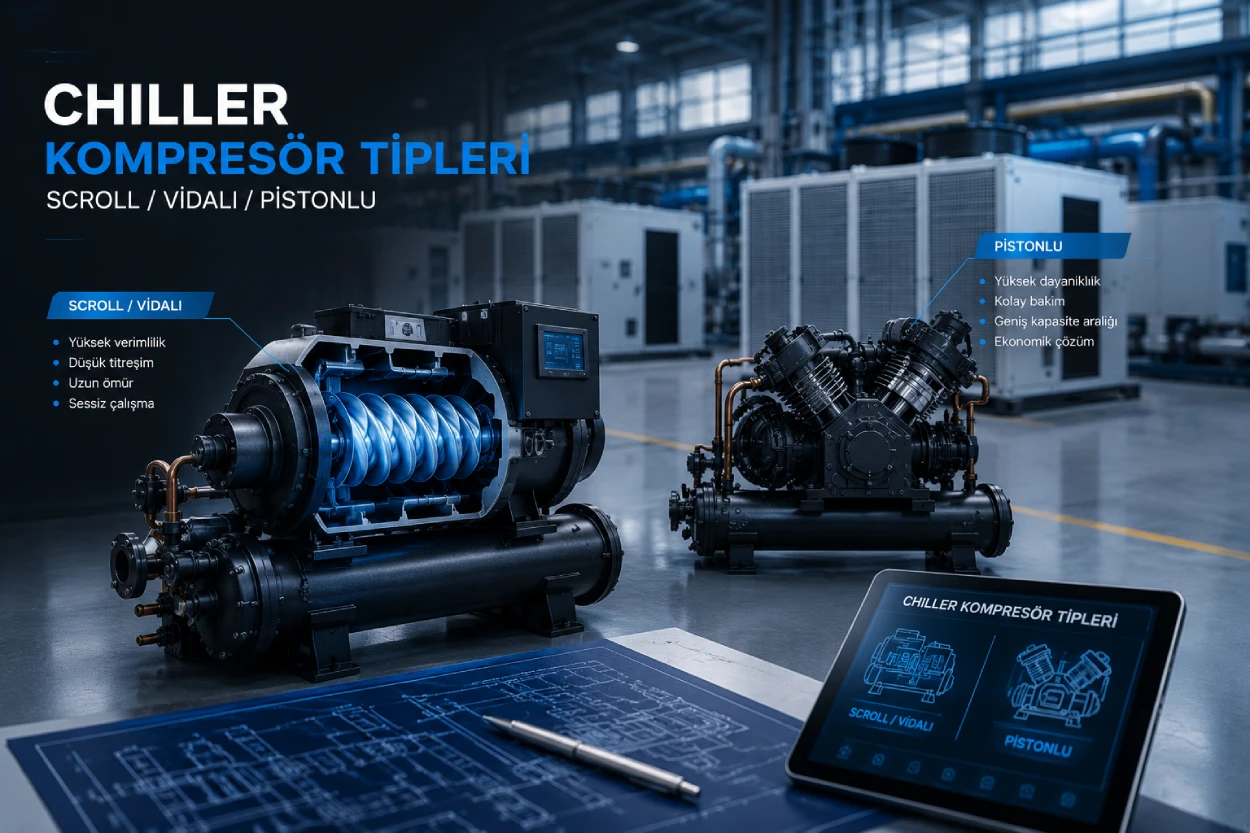
A scroll compressor progressively compresses the refrigerant between two spiral plates, one fixed and the other orbiting. It has few moving parts, which translates into low vibration, quiet operation, and high mechanical reliability. It is the most widely preferred technology in small- and medium-capacity chillers.
Capacity control is typically achieved with a multi-circuit arrangement (several scroll compressors connected in parallel): as the load drops, compressors switch off one by one, stepping the system capacity down gradually. This layout offers reasonable part-load efficiency while also providing redundancy; even if one compressor fails, the facility can keep running at partial capacity.
- Low vibration and low sound level
- High reliability and straightforward maintenance thanks to few moving parts
- Stepped capacity control and redundancy through multiple circuits
- An economical, compact solution for the small-to-medium capacity band
Screw compressor: high capacity and strong part-load efficiency
A screw compressor compresses the refrigerant continuously and without interruption through the rotation of two intermeshing helical rotors. This continuous flow delivers stable, comparatively low-vibration operation at medium and high capacities, making it ideal for process applications that run at full load for long periods.
The screw compressor's greatest strength is its part-load efficiency. A slide valve allows capacity to be modulated steplessly, and when combined with an inverter (variable-speed drive) option the compressor speed is continuously adjusted to the load demand. In facilities with variable loads this can significantly reduce annual energy consumption; the gain achieved, however, depends on the load profile and will not be the same in every application.
Reciprocating compressor: classic technology with stepped control
A reciprocating compressor is the classic technology that compresses the refrigerant with a piston moving back and forth inside a cylinder. Used for decades, it is a mature and widely understood solution, with advantages in spare-parts availability and field experience.
Capacity control is typically stepped, through cylinder loading and unloading, producing a staged behaviour similar to the multi-circuit logic of scroll units at part load. On the other hand, because of the reciprocating masses moving back and forth, these compressors generally produce higher vibration and noise; the larger number of moving parts also makes periodic maintenance somewhat more important.
What to consider when selecting the right chiller compressor
Compressor selection cannot be reduced to a single "best" technology; it varies with the facility's requirement profile. The following criteria are helpful in striking the right balance between the types:
- Capacity range: scroll stands out in the small-to-medium band and screw in the medium-to-high band, while reciprocating remains the classic option across a wide range
- Part-load efficiency: an inverter-driven screw offers an advantage under variable, long-duration loads, whereas stepped systems are simple and durable
- Noise and vibration: in acoustically sensitive environments scroll and screw are quieter than reciprocating
- Maintenance and redundancy: a multiple-scroll arrangement offers redundancy, while reciprocating stands out for field experience and parts availability
Because Planer's product range spans from roughly 16 kW up to 1,270 kW, from small to large, the compressor type differs by model and capacity band; the technology preferred at small capacities need not be the same as the one preferred at large capacities. For this reason, rather than generalisations such as "that model definitely uses that compressor," it is more accurate to make an assessment based on your application's load profile.
To identify the compressor technology best suited to your facility's load profile, operating hours, and acoustic expectations, you can consult Planer's engineering and service team and request an evaluation tailored to your application.